
SCIENCE BEHIND
Equine Hanna Somatics® (EHS)
What is POSTURE?
Abnormal or Maladaptive Compensatory Posture
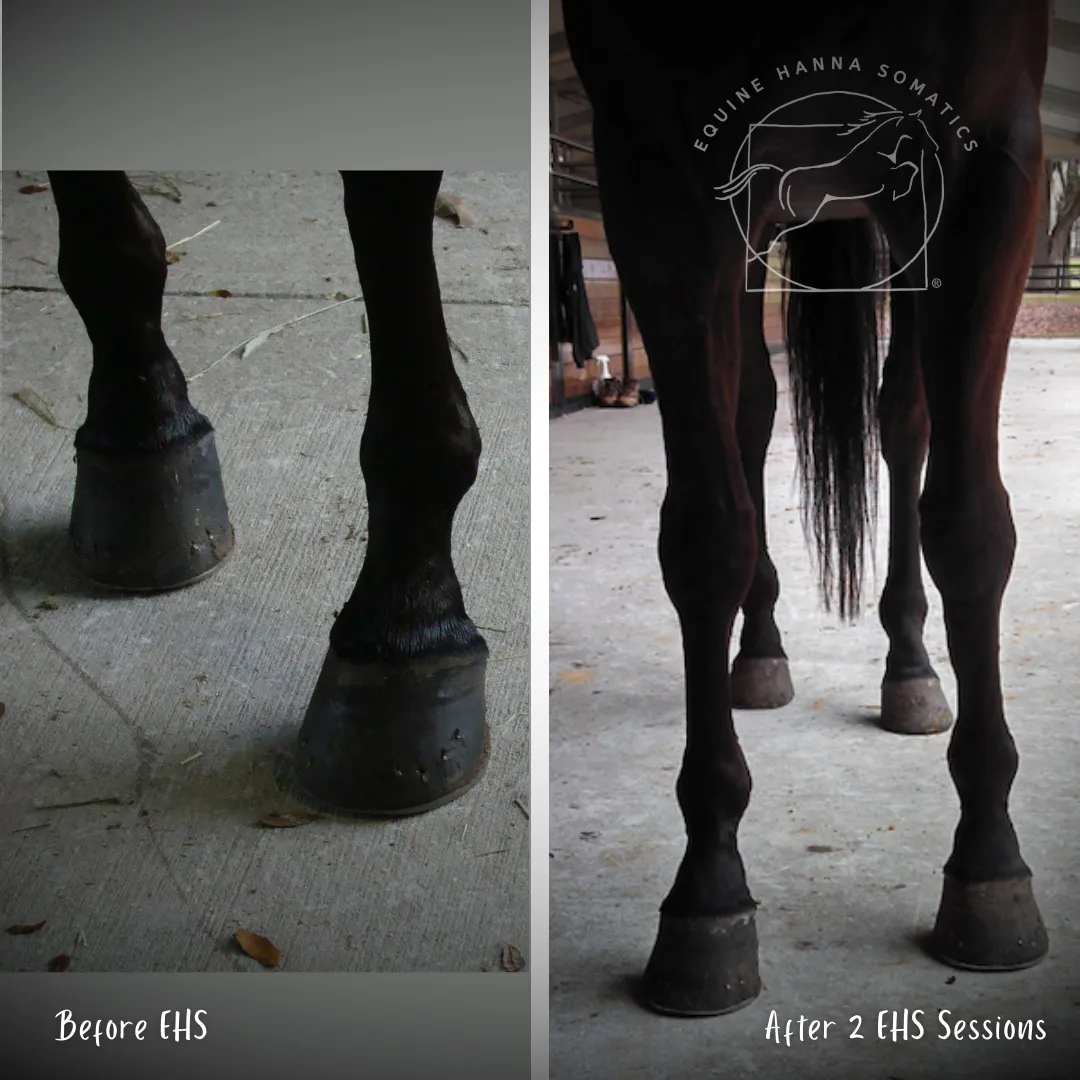


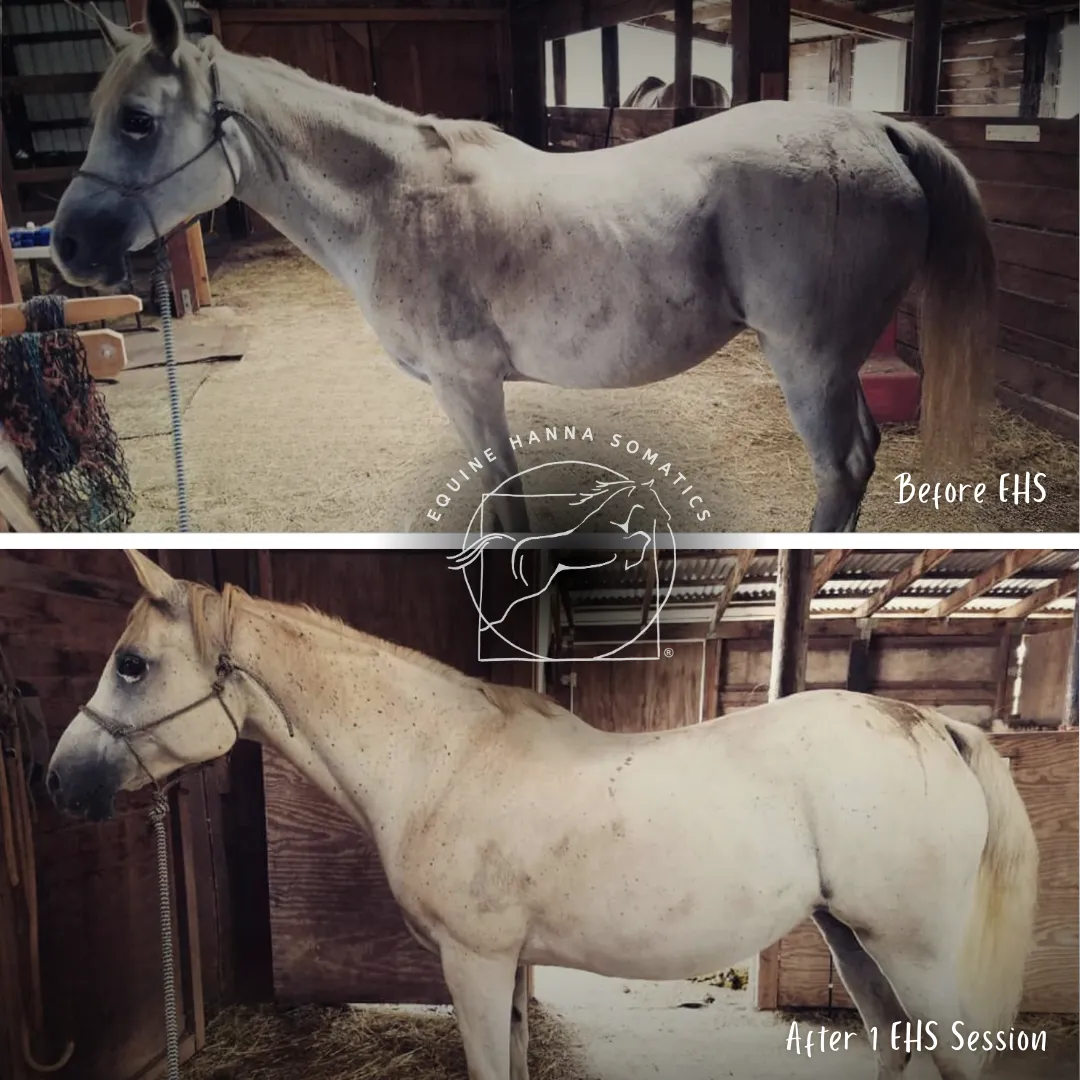
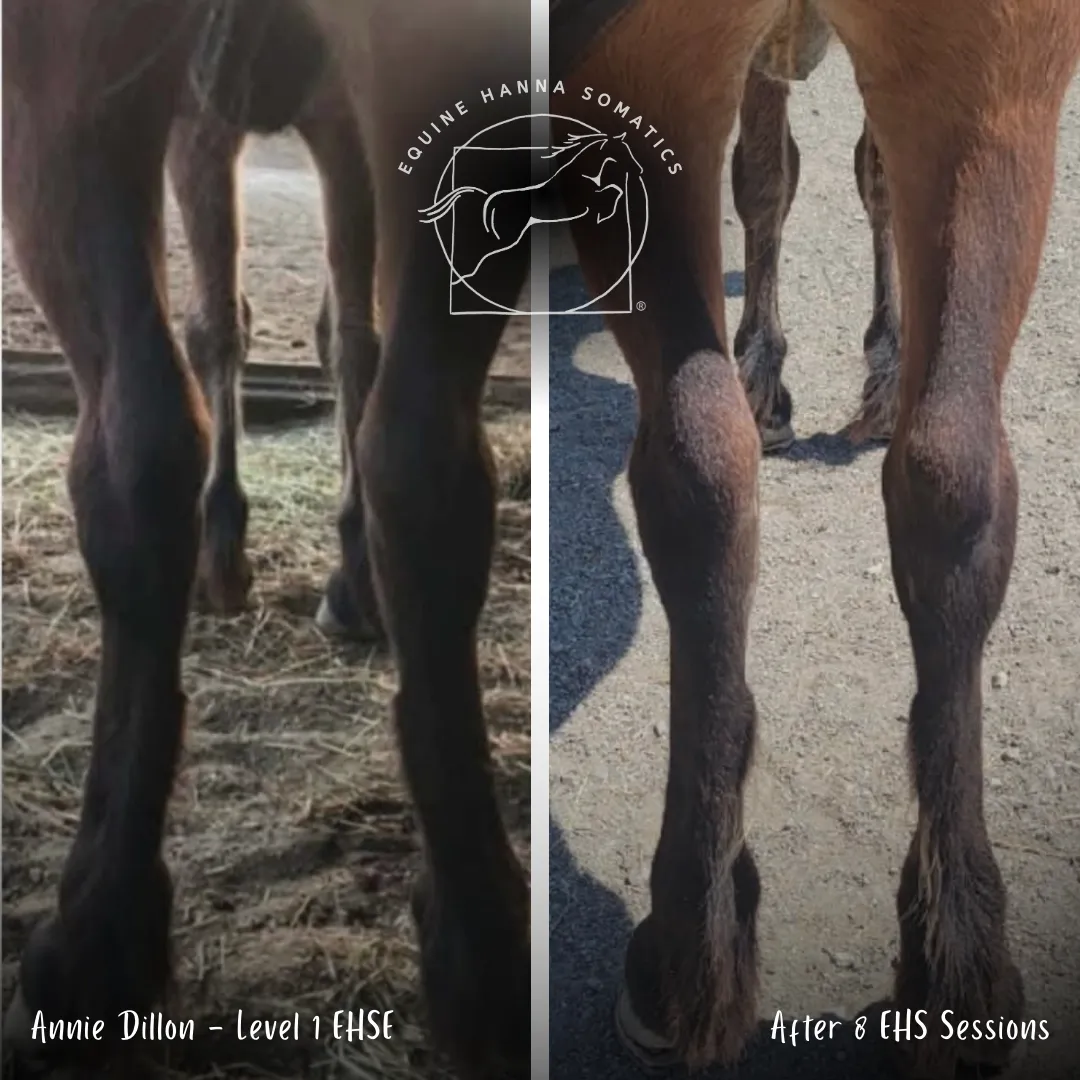

PHOTOS: Horses who presented with various examples of the characteristic maladaptive compensatory habitual postures typically reversible with Equine Hanna Somatics® Education.
Posture is an unconsciously mediated adaptive process of the nervous system that organizes the body as best it can to remain upright and in equilibrium against gravity and environmental factors, moment by moment, within the range of motion allowed by the current levels of resting myofascial tone. (Mayer 2013)
As horses adapt to their environment, they learn to keep various muscles habitually contracted, creating persistent areas of elevated resting myofascial tonus (aka tension).
It is this persistent tension that pulls the horse out of his or her natural alignment, creates postural patterns, and negatively impacts movement, soundness and well-being.
And once it's learned, it becomes the 'new normal' default posture that is maintained by involuntarily mediated motor output coming from the brain stem...
REFERENCES
Cacciatore, T. W., Anderson, D. I., & Cohen, R. G. (2024). Central mechanisms of muscle tone regulation: implications for pain and performance. Frontiers in neuroscience, 18, 1511783. https://doi.org/10.3389/fnins.2024.1511783
Criswell, E. & Mayer, A. (2006-2025) Equine Hanna Somatics® Professional Training Program Manual
Hanna, T. (1988) Somatics - Reawakening the Mind’s Control of Movement, Flexibility and Health. Da Capo Press
PHOTOS: Horses who presented with various examples of the characteristic maladaptive compensatory habitual postures typically reversible with Equine Hanna Somatics® Education.
REFERENCES
Cacciatore, T. W., Anderson, D. I., & Cohen, R. G. (2024). Central mechanisms of muscle tone regulation: implications for pain and performance. Frontiers in neuroscience, 18, 1511783. https://doi.org/10.3389/fnins.2024.1511783
Criswell, E. & Mayer, A. (2006-2025) Equine Hanna Somatics® Professional Training Program Manual
Hanna, T. (1988) Somatics - Reawakening the Mind’s Control of Movement, Flexibility and Health. Da Capo Press
The PROBLEM
Compensation and chronic tension are natural adaptive responses to stress, trauma and repetitive motion.
Manual therapy, stretching and strengthening or conscious efforts at controlling posture or 'relaxing' do not address the centrally controlled 🧠 nervous system complexities underlying muscle tone...(Cacciatore et al. 2024)
Vets, bodyworkers, physiotherapists, riders and trainers have always known relaxation and 'releases' were essential, but they were impossible to define, explain or access on demand. UNTIL NOW.
What is PANDICULATION?
Pandiculation is nature's postural reset.
Pandiculation is a natural behavior that contributes to the development and maintenance of a horse's neuromuscular integrity and mind-body integration at all ages and stages of life.
All animals spontaneously pandiculate, typically after a period of inactivity like sleeping or being confined.
Pandiculation can be done standing or laying down (ie. recumbent), and looks like a symmetrical full-body stretch, often accompanied by a yawn - or it can involve just one or two limbs at a time, or one limb and the neck, or wing… there are many variations on the ways different animals pandiculate.
Foals even pandiculate in their mother’s womb, and have been observed pandiculating up to 80 times per day after being born, as soon as on their 3rd day of life!
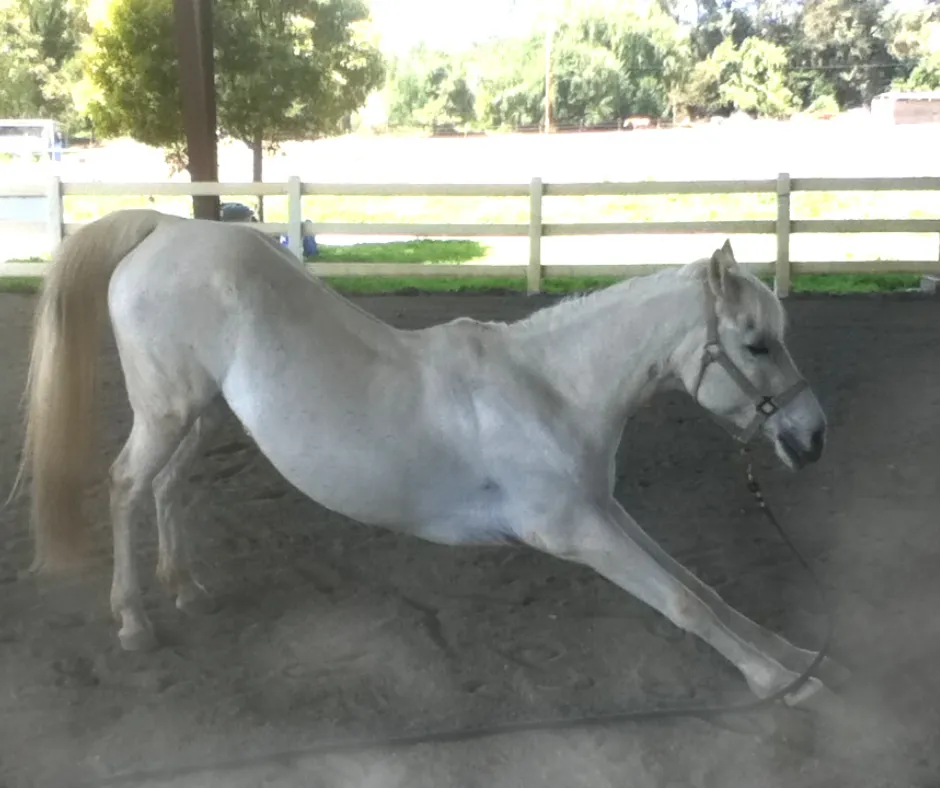
PHOTO: Aged Arabian mare demonstrating a spontaneous pandiculation reflex after an EHS session.
REFERENCES
A.F. Fraser, Pandiculation: the comparative phenomenon of systematic stretching, Applied Animal Behaviour Science, Volume 23, Issue 3, 1989, Pages 263-268, ISSN 0168-1591, https://www.sciencedirect.com/science/article/abs/pii/0168159189901172?via%3Dihub
Bertolucci L. F. (2011). Pandiculation: nature's way of maintaining the functional integrity of the myofascial system?. Journal of bodywork and movement therapies, 15(3), 268–280. https://doi.org/10.1016/j.jbmt.2010.12.006
McGreevy, P. (2012). Equine Behavior, A Guide for Veterinarians and Equine Scientists (2nd ed.) Saunders Elsevier
The SOLUTION
The solution is working WITH a horse's BRAIN, not ON a horse's BODY!
Dr. Eleanor Criswell Ed.D. created Equine Hanna Somatics® (EHS) - a hands-on method of helping horses self-correct their own default posture back to NORMAL NEUTRAL without stretching, manual manipulation or machines!
EHS is horse-centric somatic education based on the principles of basic neuroscience and the natural tendency of horses to pandiculate.
VOLUNTARY PANDICULATION
EHS is Pandiculation ON-Demand
Instead of hoping a horse spontaneously pandiculates during or after a 'treatment' - in EHS we invite the horse to actively participate in guided VOLUNTARY PANDICULATION exercises. This allows us to work strategically and efficiently with the root-cause of most muscular tension - the brain and the way it organizes it's body for movement.
By working WITH the horse's brain to engage the Pandicular Response on-demand, we can access the existing pathways and programs of the horse's nervous system to efficiently target areas of habitual tension - and facilitate the horse in normalizing them from the inside.
Equine Hanna Somatics® is the only system that teaches you how to safely and systematically harness the power of Pandiculation to help horses effect rapid and semi-permanent changes to their own baseline levels of muscle tone - from WITHIN.
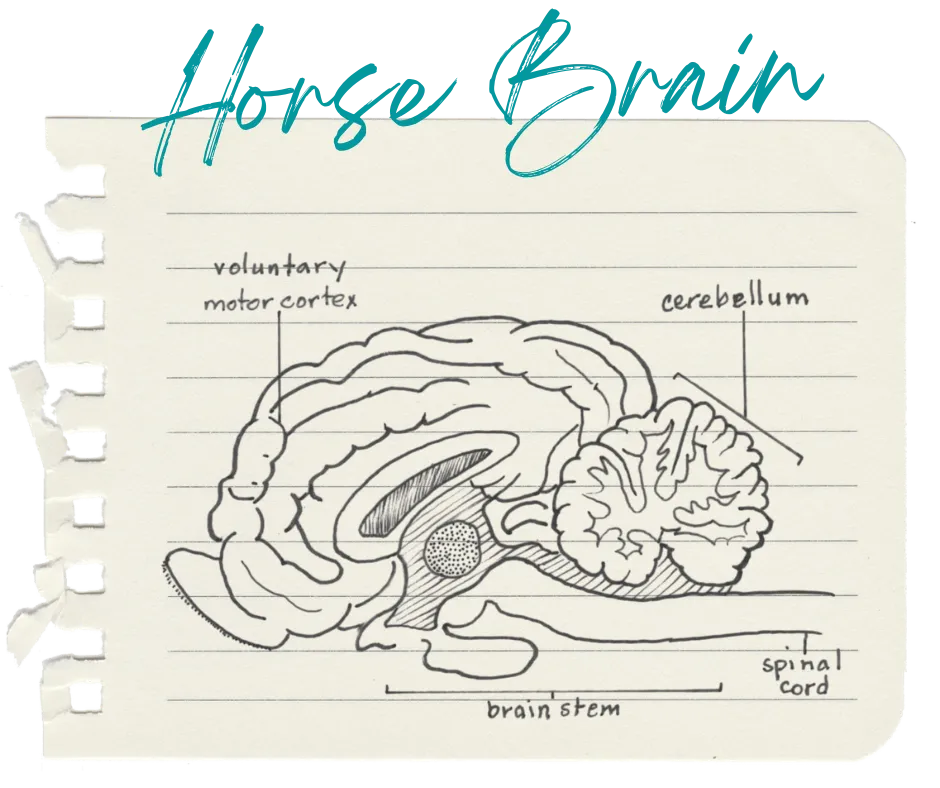
ILLUSTRATION: ©2013 Horse Brain by Barbara Chasteen, from Equine Hanna Somatics - Session 1 (introductory course)
REFERENCES:
Criswell, E. (2021) How Eleanor Criswell Created Equine Somatics (originally published 1997, Somatics Magazine: Journal of the Bodily Arts and Sciences) https://blog.equinehannasomatics.org/post/creating-equine-hanna-somatics
Hanna, T. (1990) Clinical Somatic Education: A New Discipline in the Field of Healthcare. Somatics Magazine: Journal of the Bodily Arts and Sciences, 4-10. https://equinehannasomatics.org/clinical-somatics-pdf
THIS is what WE mean when we say:
"in Equine Hanna Somatics we work WITH - not ON - horses."
Characteristic Equine Postural Presentations
The most common maladaptive compensatory postures are caused by habituated stress-responses, which typically present in one of three easily recognizable postural patterns:
Green Light Posture
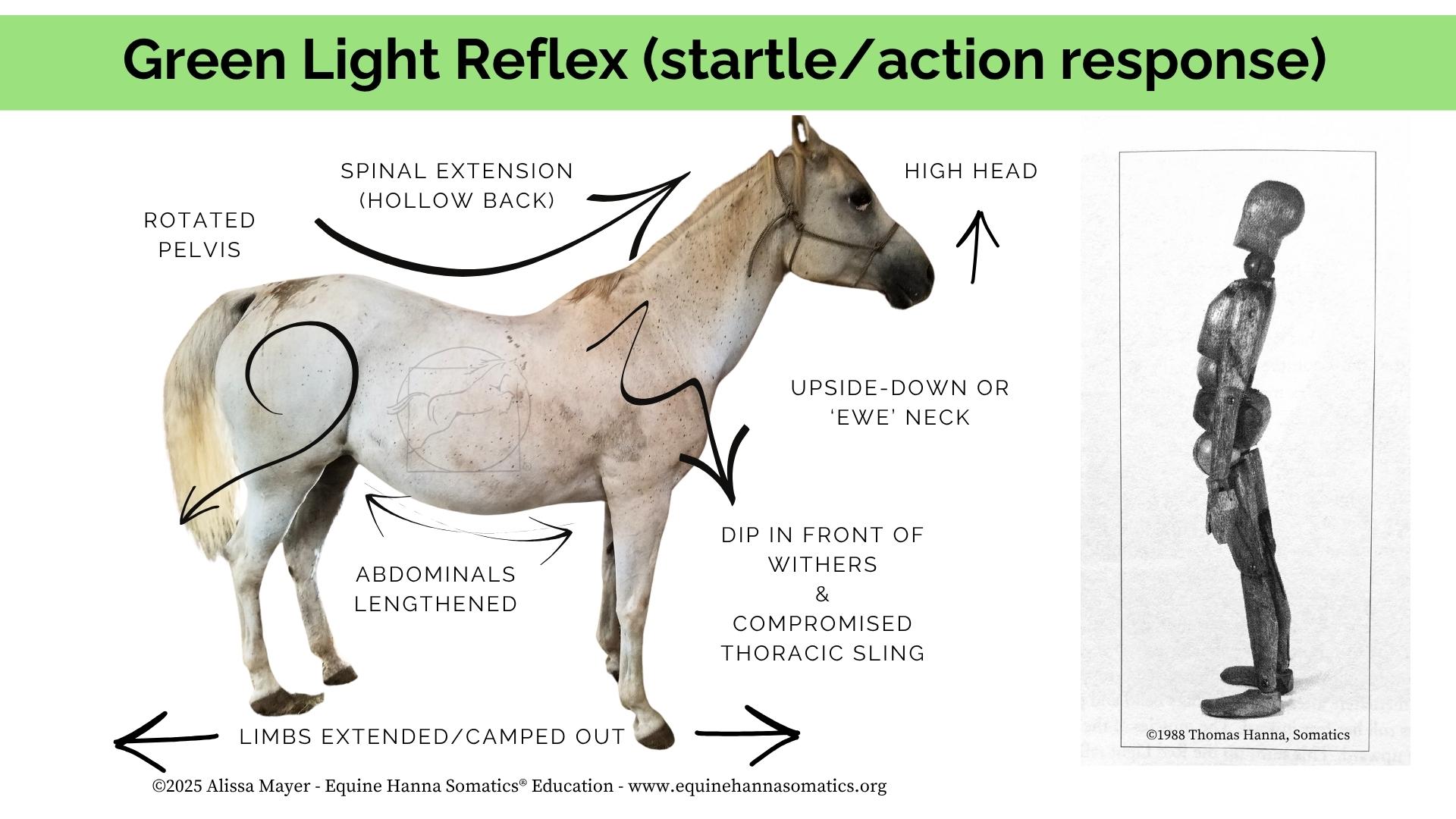
The Green Light Posture shows up when a horse is startled, afraid or excited, and is commonly known as "fight or flight." This is the Startle/Action Response.
Habitual contractions above the vertebral column produce persistent spinal extension, downward pressure on the thorax, a camped out limb position, and...
Red Light Posture
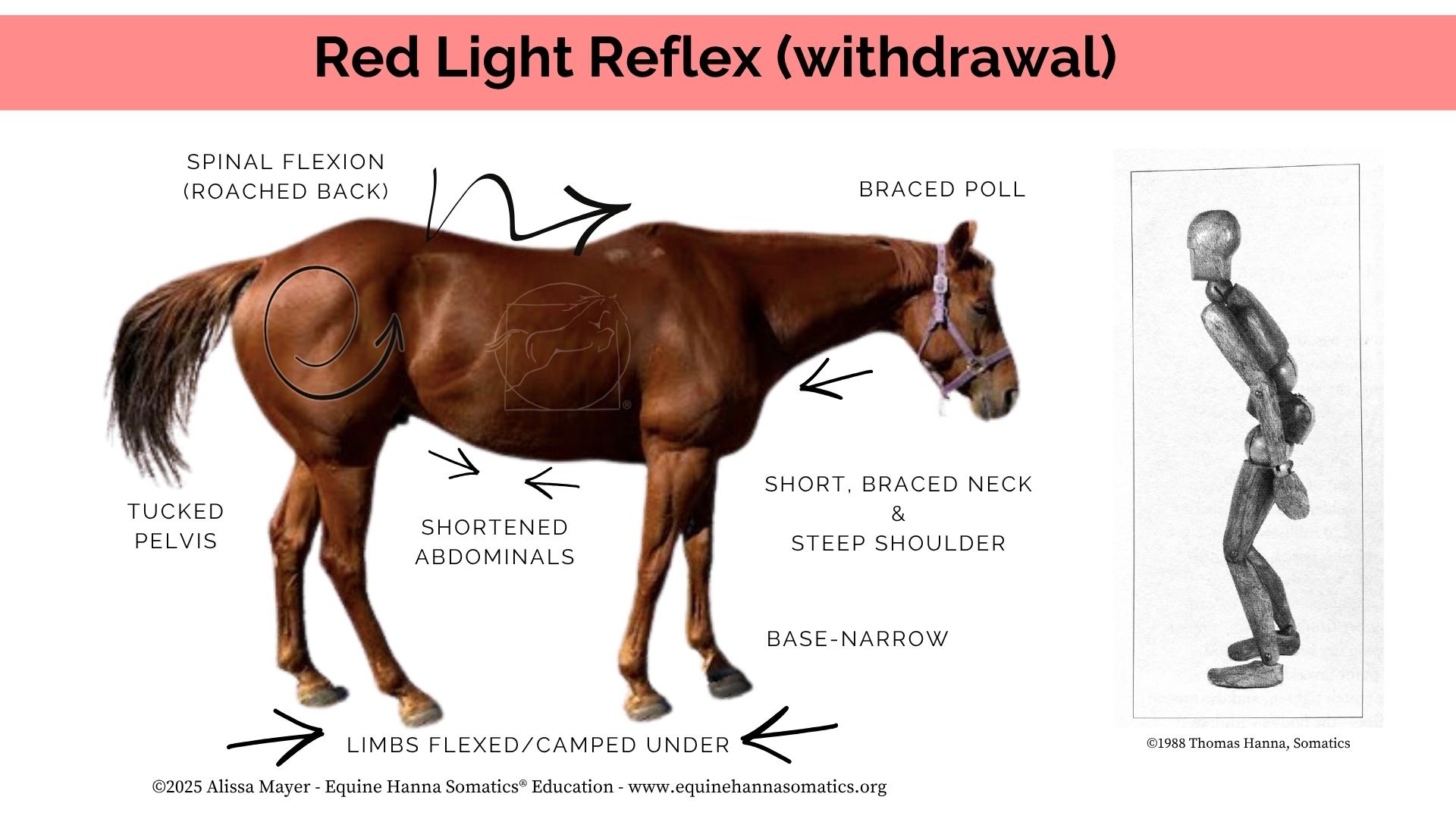
The Red Light Posture shows up when a horse is withdrawing from their reality, usually because they cannot escape confinement or pain, and is commonly referred to as "shut down" or "introverted." This is the Withdrawal Response.
Habitual contractions below the vertebral column produce persistent spinal flexion, a camped under limb position, and...
Trauma/Asymmetry Posture
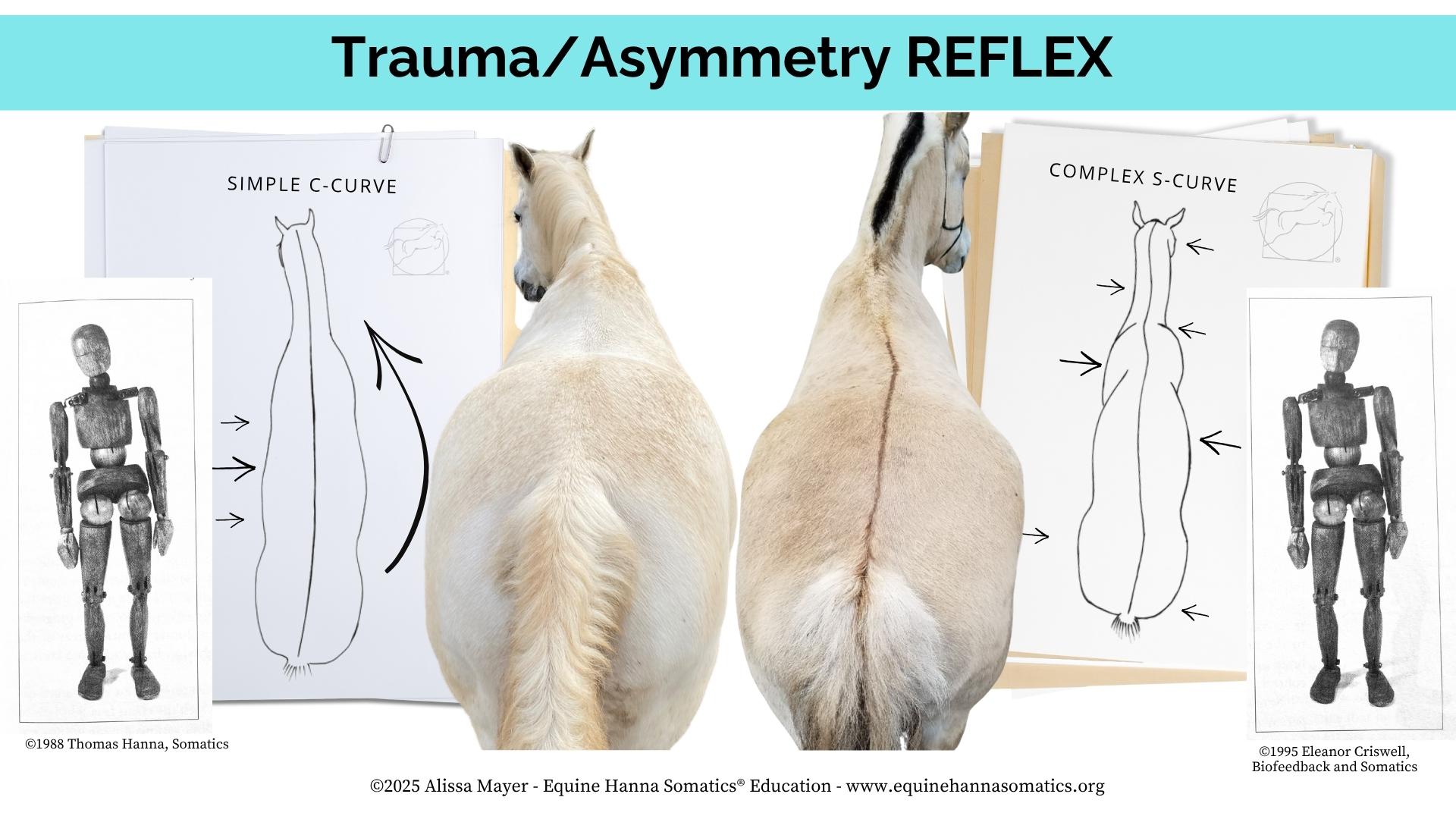
The Trauma/Asymmetry Posture (ie. crookedness) is often mistaken for laterality or "natural asymmetry" and it shows up when a horse is habitually contracting the muscles on one side of their body more strongly than the other.
This is typically an Antalgic (pain-avoidance) Response involving the withdrawal and crossed-extensor reflexes that becomes habituated, OR it can be learned from repetitive motion...
Before we can accurately assess conformation, asymmetry, soundness, strength or behavioral issues, we must identify and address the involuntary habitual tension that is pulling the horse out of alignment and creating the persistent postural deviations, functional weakness and crookedness everyone is trying to 'correct.'
The role of Equine Hanna Somatics® is to help a horse's brain recognize inefficient and unconscious muscle contractions that are no longer useful, so they can regain conscious control over their own muscles and, therefore, also regain access to their full range of motion, comfort, strength and endurance."
- Alissa Mayer, BSc(Equine) C-EHSE
Director of the EHS Professional Training Program
The BENEFITS
Case Studies and Published Research
Cognitive Enhancement
Athletic Performance
Injury Prevention
Real-life stories and studies that show the benefits of Hanna Somatic Education on body & mind.
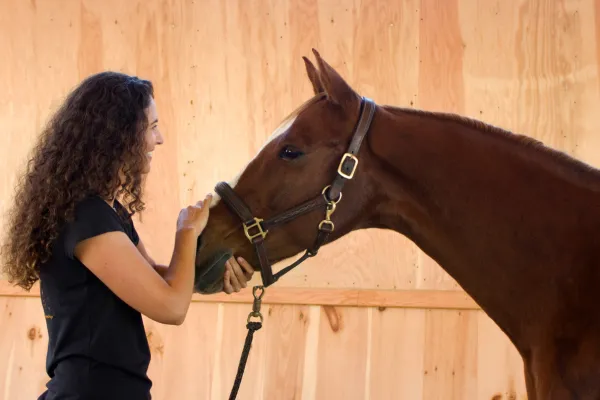
"EHS is the Future of Bodywork" (unpacked)
What do I mean when I say Equine Hanna Somatics®(EHS) is the ‘future of bodywork?’
I’m not saying that EHS should replace all bodywork, or that all existing forms of manual therapy, bodywork or therapeutic interventions are somehow inferior to EHS - that couldn’t be farther from the truth.
When I say ‘future’ - I’m talking about evolution and scientific discovery, a process in which the ‘new’ is built upon the current body of knowledge and collective experience of everyone who is or ever has contributed to a field…
The future isn’t replacement for the present, it’s a new development that has the potential to enhance what we are already doing, and give us a new lens, and sometimes new tools, to help us help horses heal and live up to their potential.
And yes, on the surface there are many similarities between various approaches to bodywork and how we work somatically with horses when we do Equine Hanna Somatics®, but underneath, there is one very distinct difference in how we are engaging with the motor-sensory system - and this difference makes ALL the difference in the world!
So what IS it that makes EHS unique in the field of somatics and different from bodywork?
⚠️ STOP ⚠️
Let me start by sharing that I am not trained in, nor have I studied all (or any one) of the different bodywork modalities out there as extensively as I have studied and practiced EHS. I am not an expert or a neuroscientist, but am speaking from my 30+ years of experience working with horses and 15 years as an Equine Hanna Somatics Educator who apprenticed directly with Eleanor Criswell and has been geeking-out on the nervous system ever since. I have worked with thousands of horses and equestrians all over the US and EU in-person, (and more online all over the world), introduced Hanna Somatics to hundreds of equine professionals, trainers, riders bodyworkers and veterinarians, and I have never come across another method that works so specifically with the horse’s brain and motor output, nor offered a comparable level of results or lasting changes, as we see daily with EHS.
In this post, I’m going to lay out for you the main reason why I believe EHS is the future of bodywork, what makes EHS unique in the field of ‘somatics’ and distinctly different from bodywork, and what that difference looks like on the inside of the nervous systems of both the horse and the human practitioner.
If YOU know something I don’t, or believe I have something wrong, after reading the whole post, please share it with me! I am a forever student and lifelong learner, and I’d love to hear from you. I committed to EHS early on when I saw it’s potential to solve most of the issues I was being hired to ‘fix’ as a horse trainer, hoof trimmer and rehabilitation specialist, in a more reliable and efficient way. The day I find something that works better or makes more sense, you’ll hear about it!
⚠️ OKAY, read on. 👇
So what makes Equine Hanna Somatics so unique and effective?
The simple answer is that EHS is a motor intervention, rather than a sensory one.
Let’s unpack that statement tho - because there is a lot in there.
The Motor-Sensory System
First, let’s acknowledge that the motor-sensory system exists in a living body as an infinite, unbreakable loop inside the nervous system, by design. The sensory side consists of all the sensory input coming into the body from the outside (exteroception) or generated from the inside by receptors scattered all throughout the various organs (interoception) and tissues like joints, muscles and fascia (proprioception).
As bodyworkers, physiotherapists or veterinarians work ‘on’ horses, they are providing a myriad of different types of sensory input to the nervous system.
The motor side consists of all the excitatory and inhibitory motor output (impulses) generated by various areas of the brain and spinal cord, and delivered to the muscles all over the body, causing them to contract and produce the forces that create movement and contribute to the biotensegrity of the whole body.
Manual therapy, bodywork and most alternative therapeutic applications work by providing specific types or quantities of sensory input to the nervous system, in various ways. This sensory input may or may not inspire a motor response from the horse. Some interventions inspire very predicable or specific motor responses, while others are more general and unpredictable, but the emphasis is on the sensory inputs.
With EHS, there is also sensory input involved - because it’s happening all the time and we can’t stop it - but when we put our hands on the horse to invite a voluntary pandiculation (which is the bulk of what we do in our sessions), we are not using a particular type of touch, or pressure, or applying a technique to the tissues, nor looking for any specific response from the tissues. We use our hands to communicate an idea to the horse. We touch the horse because we can’t explain verbally what we want the horse to do - “pick up your foot, extend your leg out in front of you, and very slowly bring it back underneath you to put your foot back on the ground and weight it.”
The sensory input we provide is non-specific and variable, and if you can communicate to your horse what to do without touching them at all, the EHS session will still be effective, or may even be more effective, than if you have your hands on the horse, because the changes come from the horse changing their motor output.
This is what makes EHS a ‘motor intervention’ and bodywork a ‘sensory intervention.’ They may look the same on the surface at times, but what is happening inside the nervous system of both the horse AND of the human practitioner is quite different.
And this is where it gets really interesting…
EHS is a Motor-Intervention VS. Bodywork is a Sensory Intervention
When a bodyworker applies a technique to a horse, whether it’s hands-on massage or mobilization, stimulation of points with pressure, energy or needles, gentle spinal manipulation, or a machine modality - the human is producing a lot of motor output during the session, moving their body about, working hands-on to apply their techniques, fiddling with their equipment, moving the horse around, etc.
The horse is largely a passive participant in bodywork, allowing the human to do their work, and receiving the sensory inputs provided. At times the horse also produces motor output, either in response to something the practitioner does (blinking, yawning, moving, even pandiculating) or in response to the environment (flies, handler, grass, wind, feed-cart rolling by, etc.) - but the motor responses are mostly non-specific and variable. The emphasis is on the sensory experience being provided to the horse.
When an Equine Hanna Somatics Educator works with a horse, they are also producing motor output to control their own body as they move around the horse, and providing various sensory inputs to the horse, but the purpose of each human movement or touch is to inspire the horse to produce their own motor output in response.
There are various ways to ask a horse to do one of the basic somatic movements, which is why the type of sensory input we use is generally non-specific and frankly not very important other than it shouldn’t be too distracting, shouldn’t trigger a reflex or conditioned cue, shouldn’t be forceful, painful or ticklish or threatening, etc.
The horse is an active participant in EHS, not moving randomly or spontaneously, but is producing a highly specific type of motor output during our sessions.
Levels of Nervous System Engagement in Hanna Somatics
The motor output we are asking for during a Voluntary Pandiculation exercise comes from the voluntary motor cortex of the horse’s brain - which only happens when the horse does a voluntary movement (and does it slowly enough).
The motor output we are asking for during Kinetic Mirroring comes from the spinal cord, and happens when the Golgi Tendon Organs are stimulated. And occasionally we use a technique called Meanswhereby, which is similar to a passive range-of-motion movement that is performed by the human - but this is only used when the horse is having difficulty understanding what we are asking, or in finding or feeling the part of their body we are asking them to move.
The emphasis in EHS is on the voluntary motor output being produced by the horse, specifically during both the concentric and eccentric phases of muscle contractions. This is what makes Hanna Somatics a motor intervention, vs. a sensory intervention like bodywork.
In both cases, the human practitioner is using a lot of motor output to control their own body, and is providing sensory input to the horse’s body. In both cases the horse is also producing motor output and receiving sensory input.
The difference is in the specificity, the emphasis, and the level of active nervous system engagement - and in the results.
In Summary
Bodywork applies specific sensory input via specific techniques targeted at specific musculoskeletal tissues; the horse’s motor output is variable and non-specific, and the horse offers spontaneous responses.
EHS makes use of non-specific sensory input as communication; the horse’s motor output is highly specific and comes from particular areas of the central nervous system, and the horse is asked for deliberate voluntary responses.
The big-picture goals of bodywork and Hanna Somatics are very similar, and often the initial outcomes are also similar - but results differ in degree, how long they last and whether they need to be repeated or supported with additional training or strengthening… but these we’ll save for another time to discuss!
So when I say that ‘Equine Hanna Somatics is the future of bodywork,’ I’m not suggesting that EHS is going to replace bodywork.
I’m saying that I believe EHS is the next natural step in the evolution of our field, and I want to live in a world where all horses are free from their accumulated habitual tension so they can live up to their potential and find joy in movement again - and every day!
🦄
EHS is not something that can be done TO a horse by the practitioner, but is a voluntary activity that we facilitate. It's a guided conversation we invite a horse to have WITH their own nervous system."
- Ryan Moschell LMT, CHSE
Director of the HSE Professional Training Program, EHS Education Co-instructor
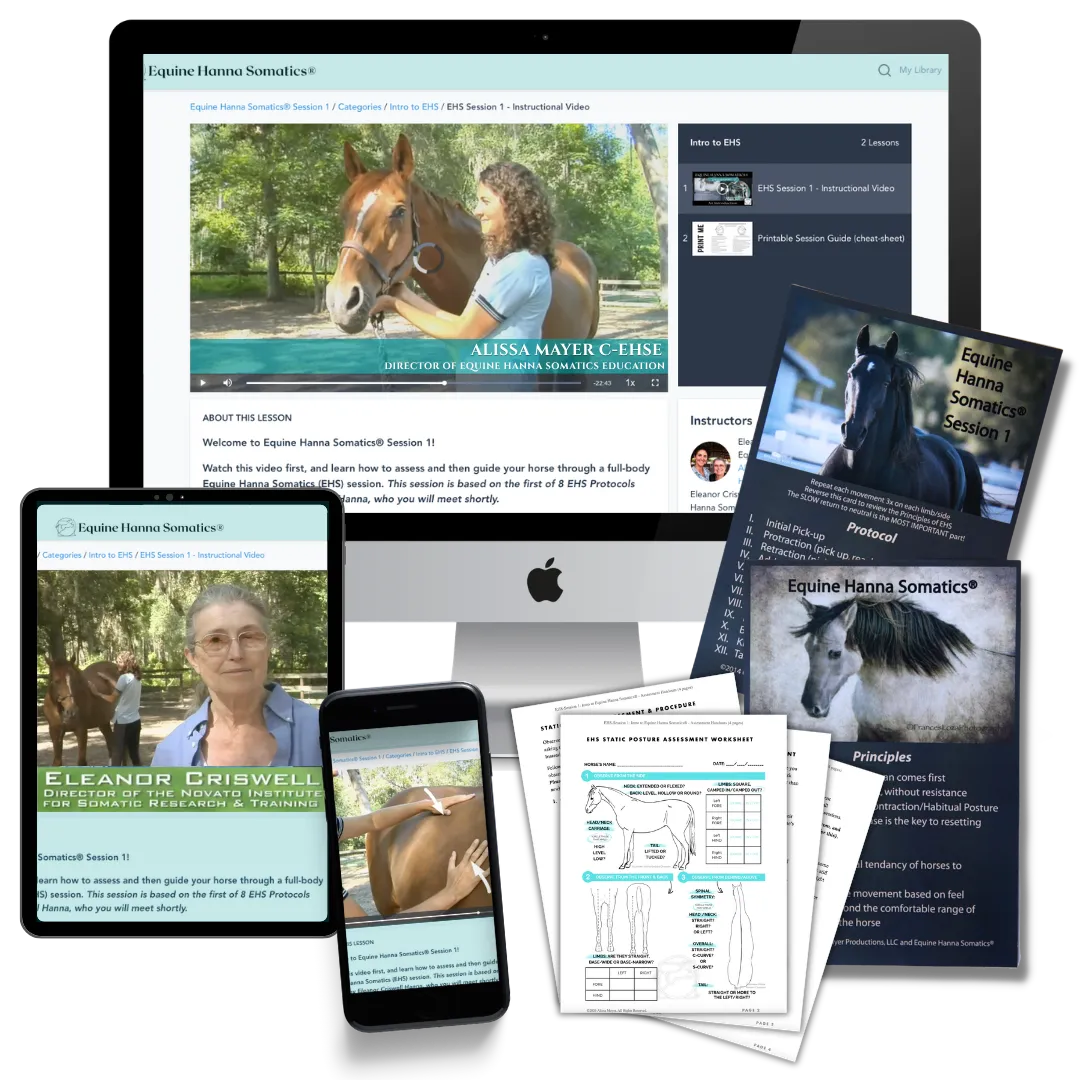
GET THE INTRODUCTORY ONLINE COURSE
Equine Hanna Somatics - SESSION 1
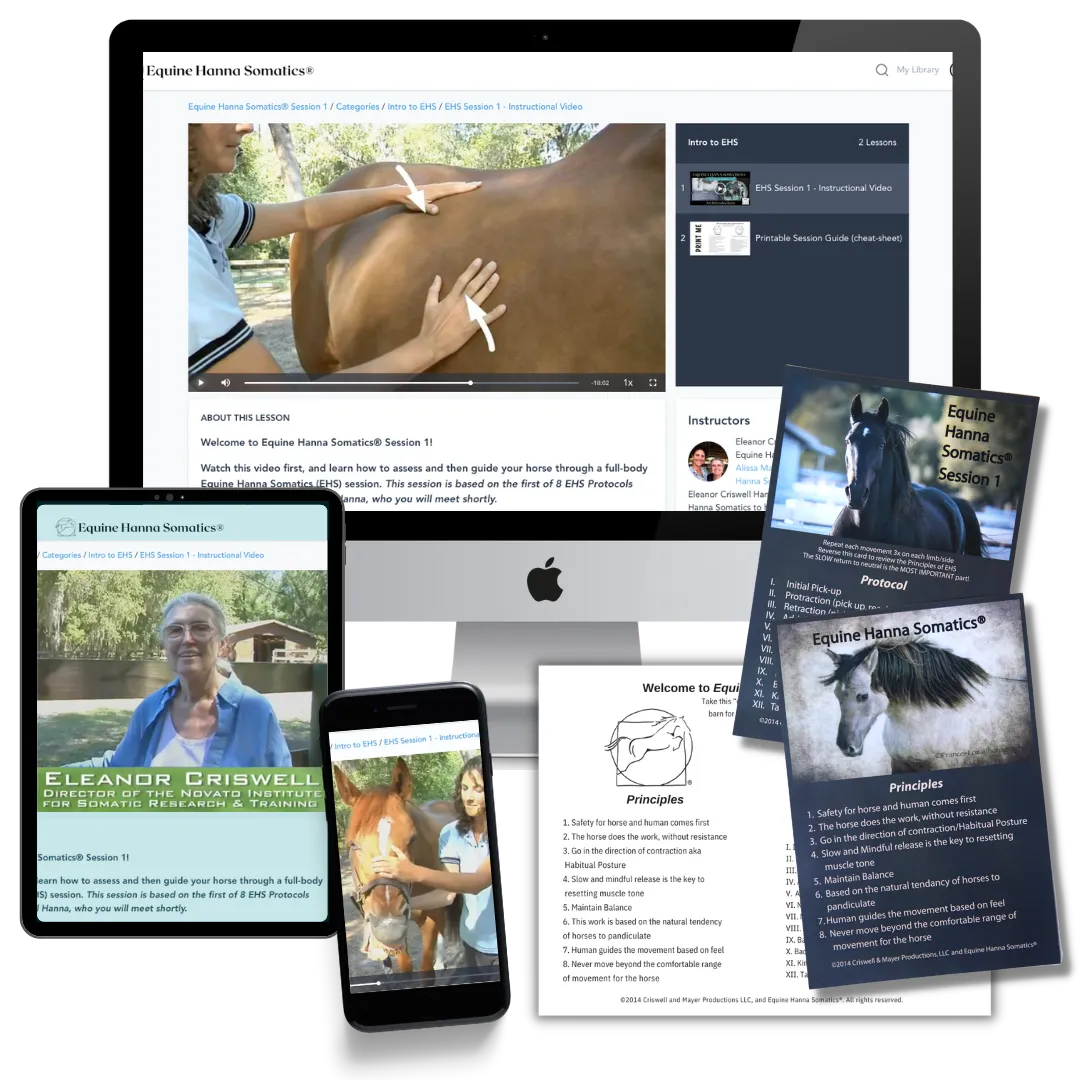
Watch a full-body Equine Hanna Somatics® session, including pre- and post-session assessments, and learn how to start doing EHS with your own horse, TODAY!
Disclaimer: Equine/Canine/Human Hanna Somatics is not bodywork or manual therapy, and is not a diagnostic or treatment tool. The information included on this website and in any affiliated programs is intended for educational purposes only and is not meant to take the place of professional veterinary or medical advice, may not be current, and is subject to change without notice. We encourage all members of the community to seek guidance from a licensed veterinarian, physician or allied healthcare practitioner regarding specific medical concerns or questions about your own or your animal’s health.
EQUINE HANNA SOMATICS® EDUCATION


INFO
LEARN
LEGAL
©2014-2026 Criswell & Mayer Productions LLC and Feel, Embodied LLC. All Rights Reserved.