
SCIENCE BEHIND
Equine Hanna Somatics® (EHS)
What is POSTURE?
Abnormal or Maladaptive Compensatory Posture
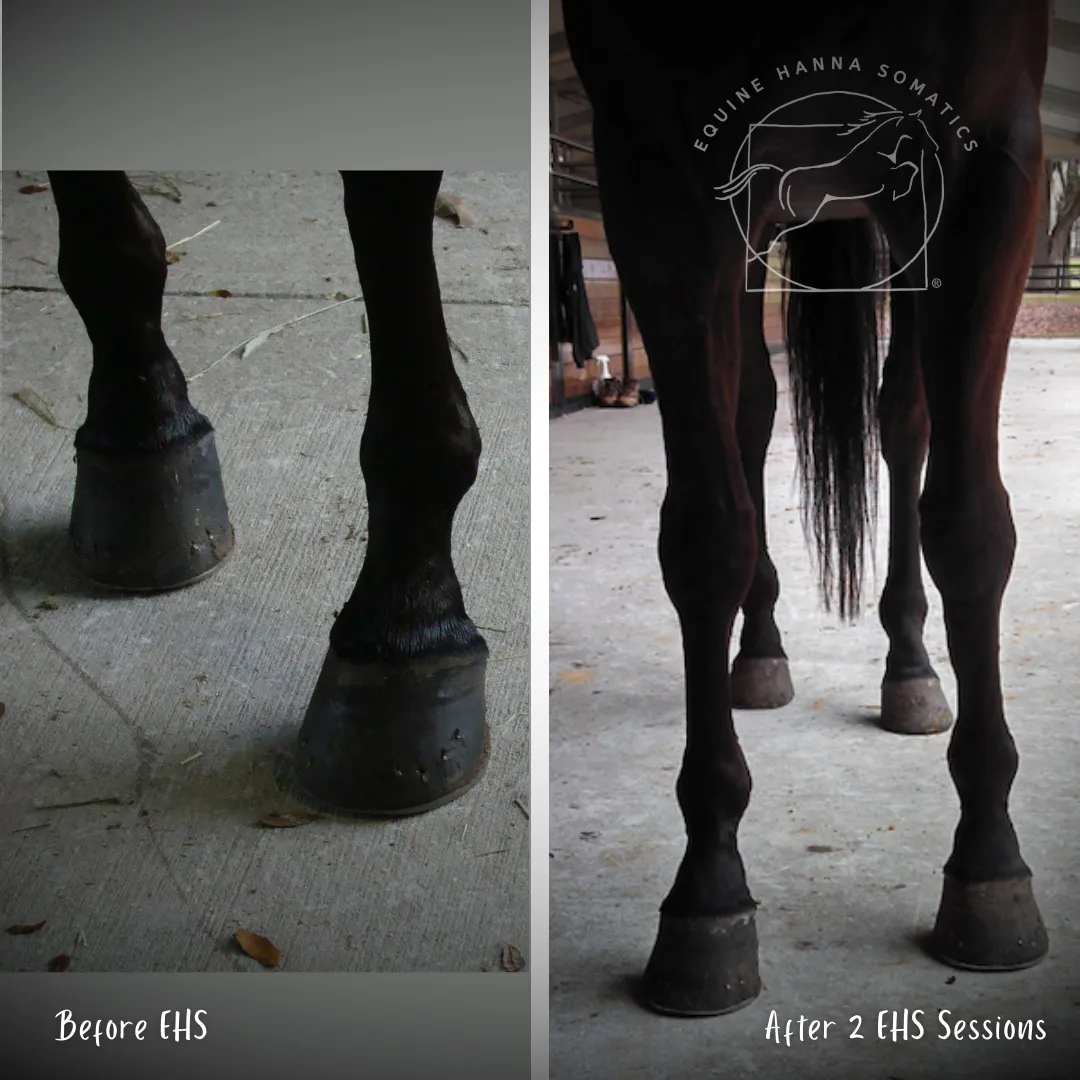


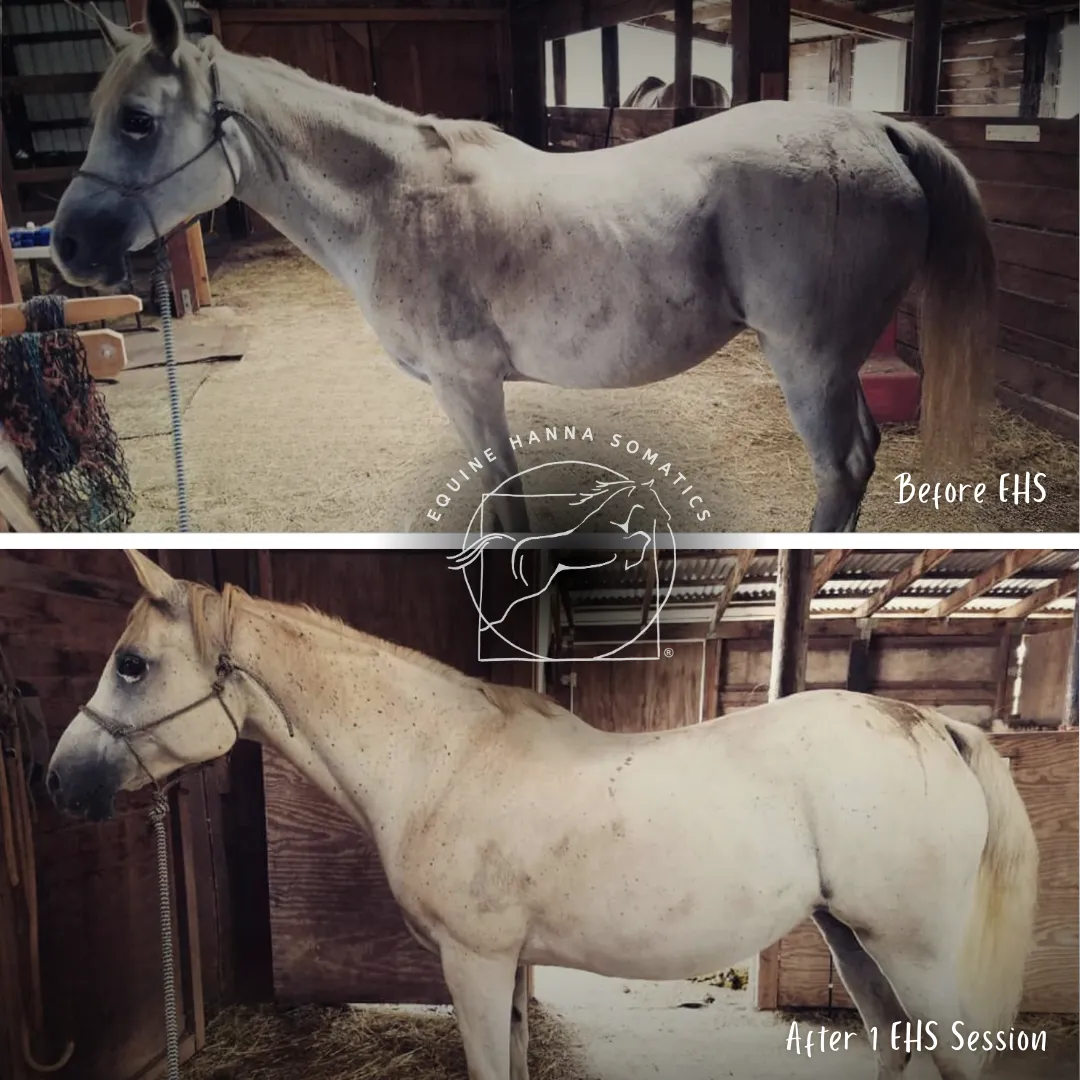
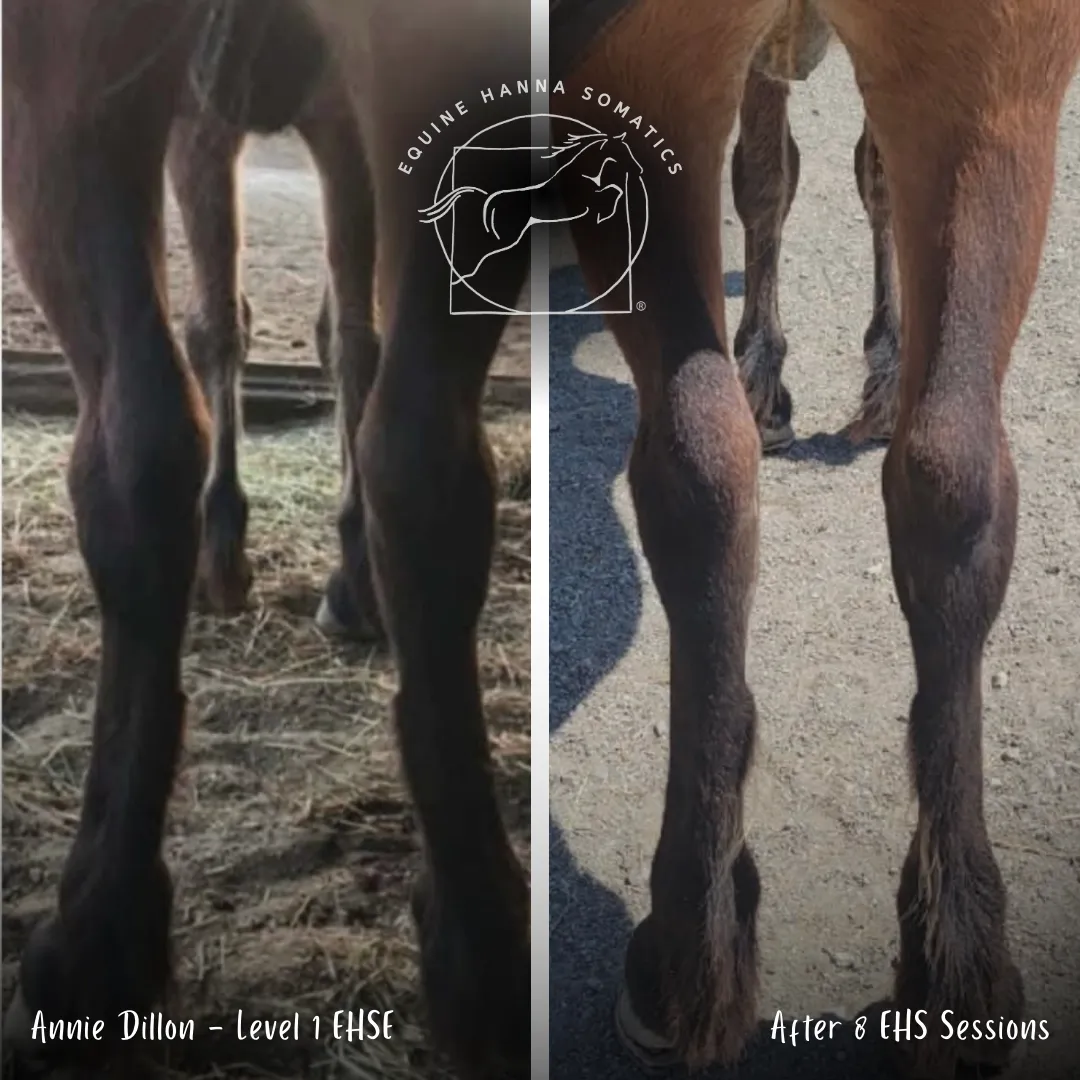

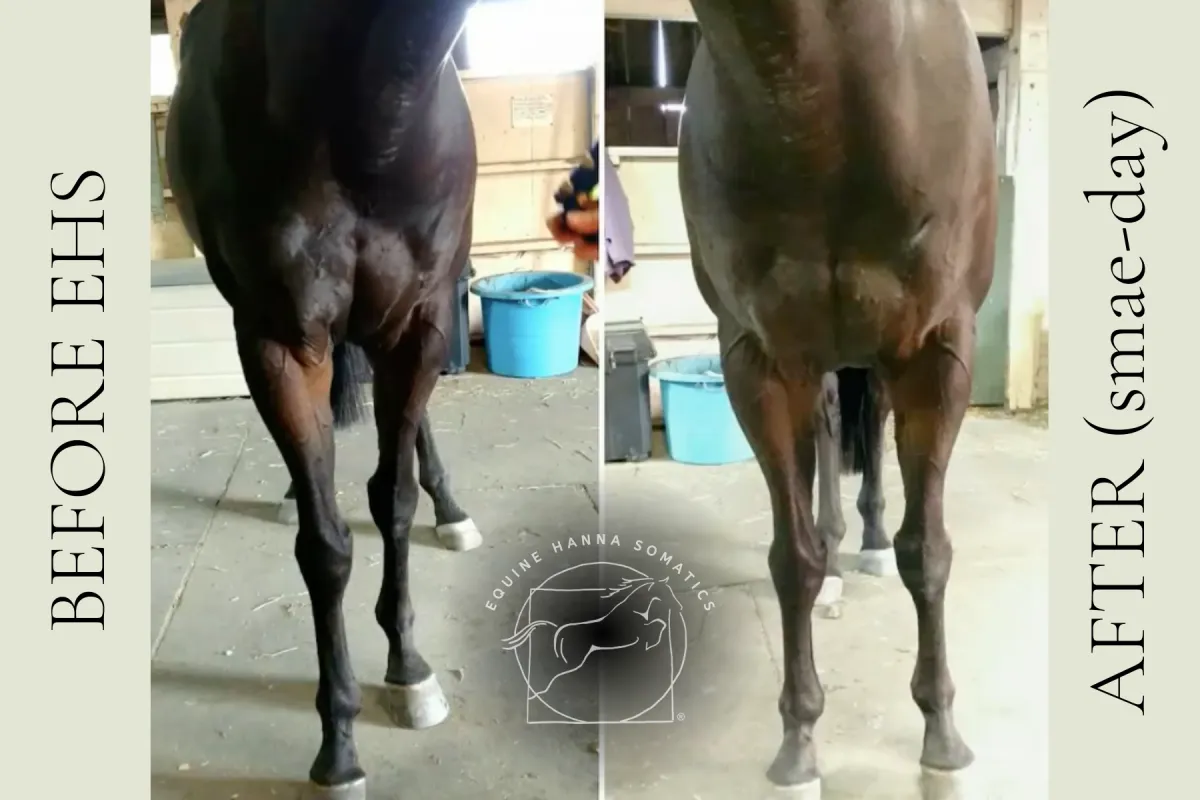
PHOTOS: Horses who presented with various examples of the characteristic maladaptive compensatory habitual postures typically reversible with Equine Hanna Somatics® Education.
Posture is an unconsciously mediated adaptive process of the nervous system that organizes the body as best it can to remain upright and in equilibrium against gravity and environmental factors, moment by moment, within the range of motion allowed by the current levels of resting myofascial tone. (Mayer 2013)
As horses adapt to their environment, they learn to keep various muscles habitually contracted, creating persistent areas of elevated resting myofascial tonus (aka tension).
It is this persistent tension that pulls the horse out of his or her natural alignment, creates postural patterns, and negatively impacts movement, soundness and well-being.
And once it's learned, it becomes the 'new normal' default posture that is maintained by involuntarily mediated motor output coming from the brain stem...
REFERENCES
Cacciatore, T. W., Anderson, D. I., & Cohen, R. G. (2024). Central mechanisms of muscle tone regulation: implications for pain and performance. Frontiers in neuroscience, 18, 1511783. https://doi.org/10.3389/fnins.2024.1511783
Criswell, E. & Mayer, A. (2006-2025) Equine Hanna Somatics® Professional Training Program Manual
Hanna, T. (1988) Somatics - Reawakening the Mind’s Control of Movement, Flexibility and Health. Da Capo Press
PHOTOS: Horses who presented with various examples of the characteristic maladaptive compensatory habitual postures typically reversible with Equine Hanna Somatics® Education.
REFERENCES
Cacciatore, T. W., Anderson, D. I., & Cohen, R. G. (2024). Central mechanisms of muscle tone regulation: implications for pain and performance. Frontiers in neuroscience, 18, 1511783. https://doi.org/10.3389/fnins.2024.1511783
Criswell, E. & Mayer, A. (2006-2025) Equine Hanna Somatics® Professional Training Program Manual
Hanna, T. (1988) Somatics - Reawakening the Mind’s Control of Movement, Flexibility and Health. Da Capo Press
The PROBLEM
Compensation and chronic tension are natural adaptive responses to stress, trauma and repetitive motion.
Manual therapy, stretching and strengthening or conscious efforts at controlling posture or 'relaxing' do not address the centrally controlled 🧠 nervous system complexities underlying muscle tone...(Cacciatore et al. 2024)
Vets, bodyworkers, physiotherapists, riders and trainers have always known relaxation and 'releases' were essential, but they were impossible to define, explain or access on demand. UNTIL NOW.
What is PANDICULATION?
Pandiculation is nature's postural reset.
Pandiculation is a natural behavior that contributes to the development and maintenance of a horse's neuromuscular integrity and mind-body integration at all ages and stages of life.
All animals spontaneously pandiculate, typically after a period of inactivity like sleeping or being confined.
Pandiculation can be done standing or laying down (ie. recumbent), and looks like a symmetrical full-body stretch, often accompanied by a yawn - or it can involve just one or two limbs at a time, or one limb and the neck, or wing… there are many variations on the ways different animals pandiculate.
Foals even pandiculate in their mother’s womb, and have been observed pandiculating up to 80 times per day after being born, as soon as on their 3rd day of life!
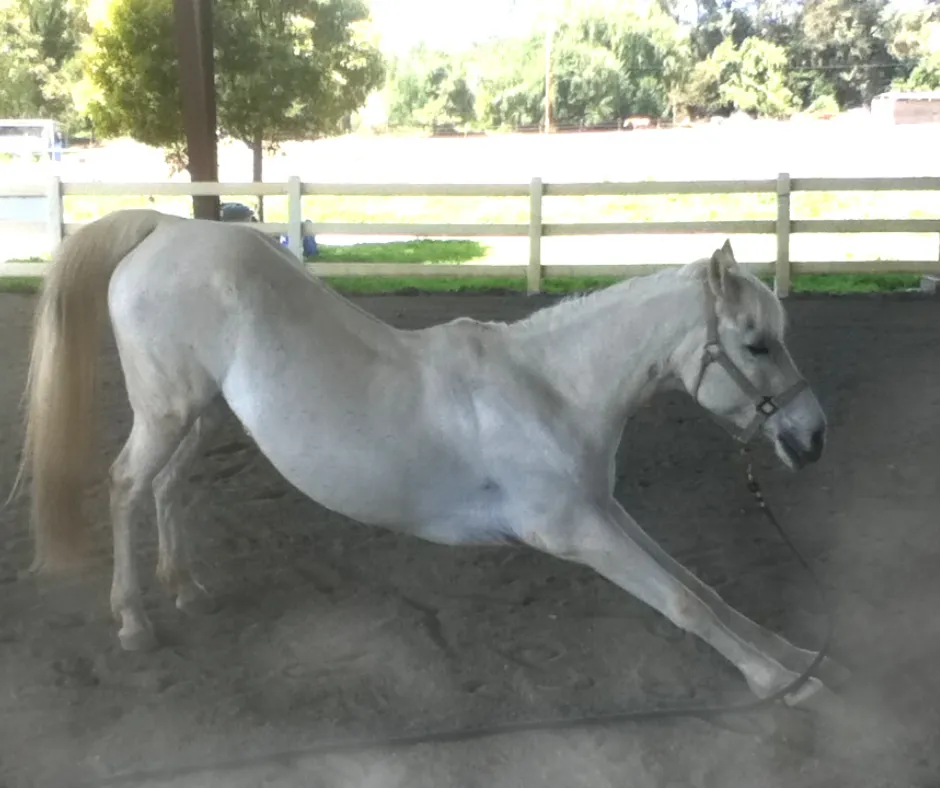
PHOTO: Aged Arabian mare demonstrating a spontaneous pandiculation reflex after an EHS session.
REFERENCES
A.F. Fraser, Pandiculation: the comparative phenomenon of systematic stretching, Applied Animal Behaviour Science, Volume 23, Issue 3, 1989, Pages 263-268, ISSN 0168-1591, https://www.sciencedirect.com/science/article/abs/pii/0168159189901172?via%3Dihub
Bertolucci L. F. (2011). Pandiculation: nature's way of maintaining the functional integrity of the myofascial system?. Journal of bodywork and movement therapies, 15(3), 268–280. https://doi.org/10.1016/j.jbmt.2010.12.006
McGreevy, P. (2012). Equine Behavior, A Guide for Veterinarians and Equine Scientists (2nd ed.) Saunders Elsevier
The SOLUTION
The solution is working WITH a horse's BRAIN, not ON a horse's BODY!
Dr. Eleanor Criswell Ed.D. created Equine Hanna Somatics® (EHS) - a hands-on method of helping horses self-correct their own default posture back to NORMAL NEUTRAL without stretching, manual manipulation or machines!
EHS is horse-centric somatic education based on the principles of basic neuroscience and the natural tendency of horses to pandiculate.
VOLUNTARY PANDICULATION
EHS is Pandiculation ON-Demand
Instead of hoping a horse spontaneously pandiculates during or after a 'treatment' - in EHS we invite the horse to actively participate in guided VOLUNTARY PANDICULATION exercises. This allows us to work strategically and efficiently with the root-cause of most muscular tension - the brain and the way it organizes it's body for movement.
By working WITH the horse's brain to engage the Pandicular Response on-demand, we can access the existing pathways and programs of the horse's nervous system to efficiently target areas of habitual tension - and facilitate the horse in normalizing them from the inside.
Equine Hanna Somatics® is the only system that teaches you how to safely and systematically harness the power of Pandiculation to help horses effect rapid and semi-permanent changes to their own baseline levels of muscle tone - from WITHIN.
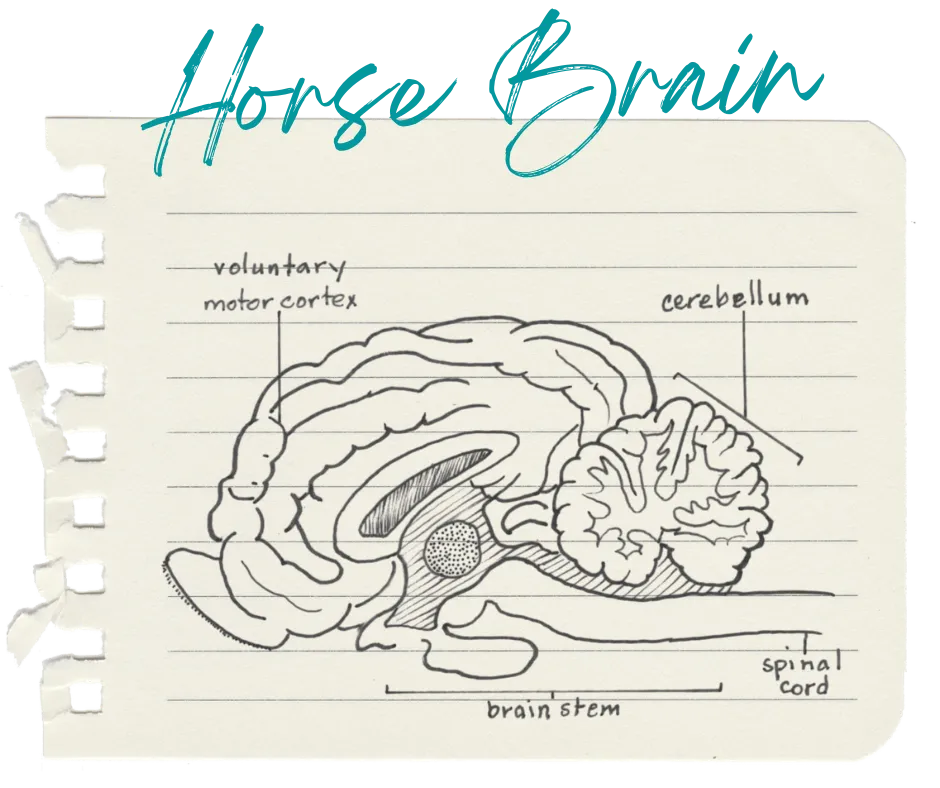
ILLUSTRATION: ©2013 Horse Brain by Barbara Chasteen, from Equine Hanna Somatics - Session 1 (introductory course)
REFERENCES:
Criswell, E. (2021) How Eleanor Criswell Created Equine Somatics (originally published 1997, Somatics Magazine: Journal of the Bodily Arts and Sciences) https://blog.equinehannasomatics.org/post/creating-equine-hanna-somatics
Hanna, T. (1990) Clinical Somatic Education: A New Discipline in the Field of Healthcare. Somatics Magazine: Journal of the Bodily Arts and Sciences, 4-10. https://equinehannasomatics.org/clinical-somatics-pdf
THIS is what WE mean when we say:
"in Equine Hanna Somatics we work WITH - not ON - horses."
Characteristic Equine Postural Presentations
The most common maladaptive compensatory postures are caused by habituated stress-responses, which typically present in one of three easily recognizable postural patterns:
Green Light Posture
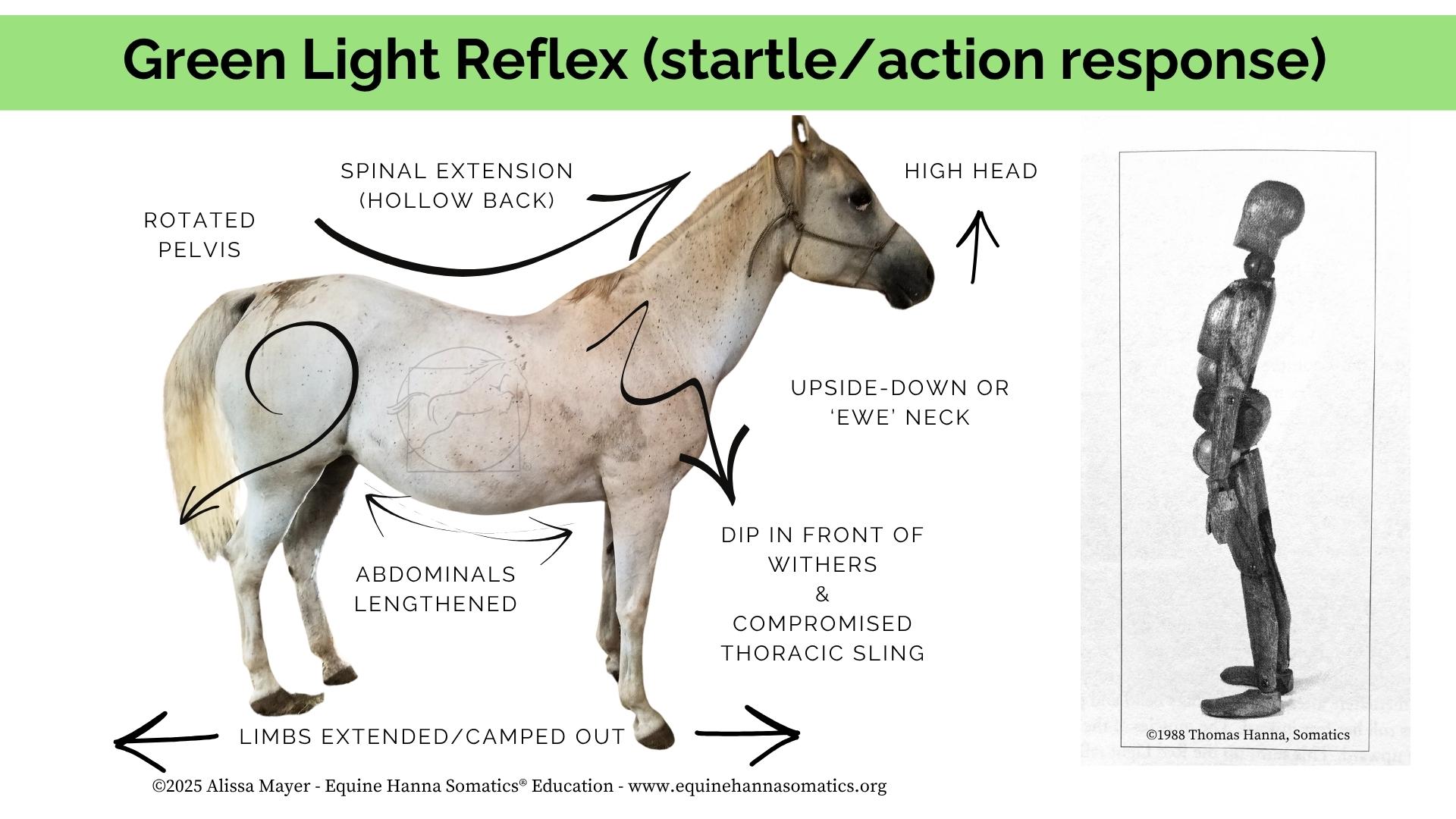
The Green Light Posture shows up when a horse is startled, afraid or excited, and is commonly known as "fight or flight." This is the Startle/Action Response.
Habitual contractions above the vertebral column produce persistent spinal extension, downward pressure on the thorax, a camped out limb position, and...
Red Light Posture
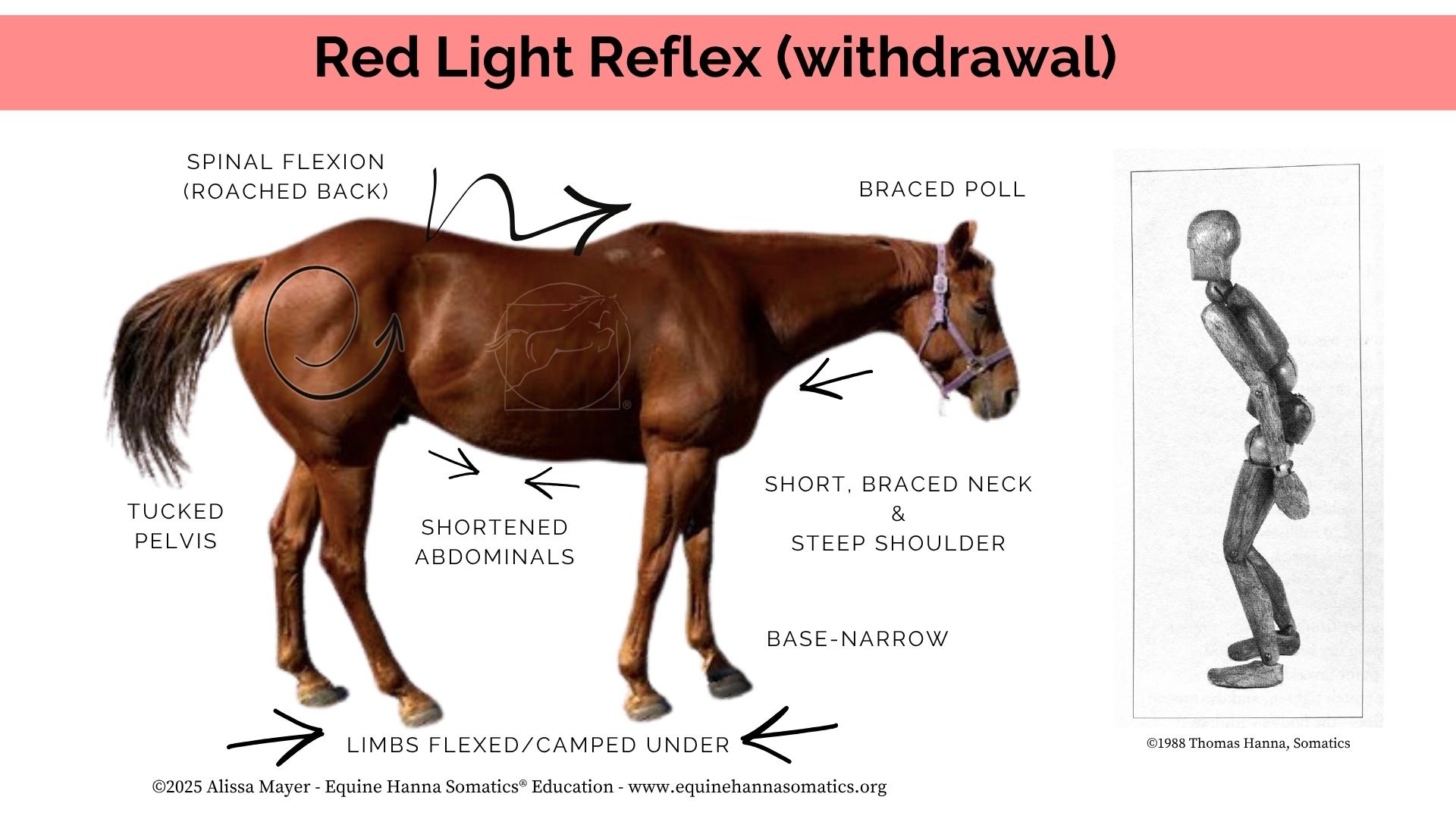
The Red Light Posture shows up when a horse is withdrawing from their reality, usually because they cannot escape confinement or pain, and is commonly referred to as "shut down" or "introverted." This is the Withdrawal Response.
Habitual contractions below the vertebral column produce persistent spinal flexion, a camped under limb position, and...
Trauma/Asymmetry Posture
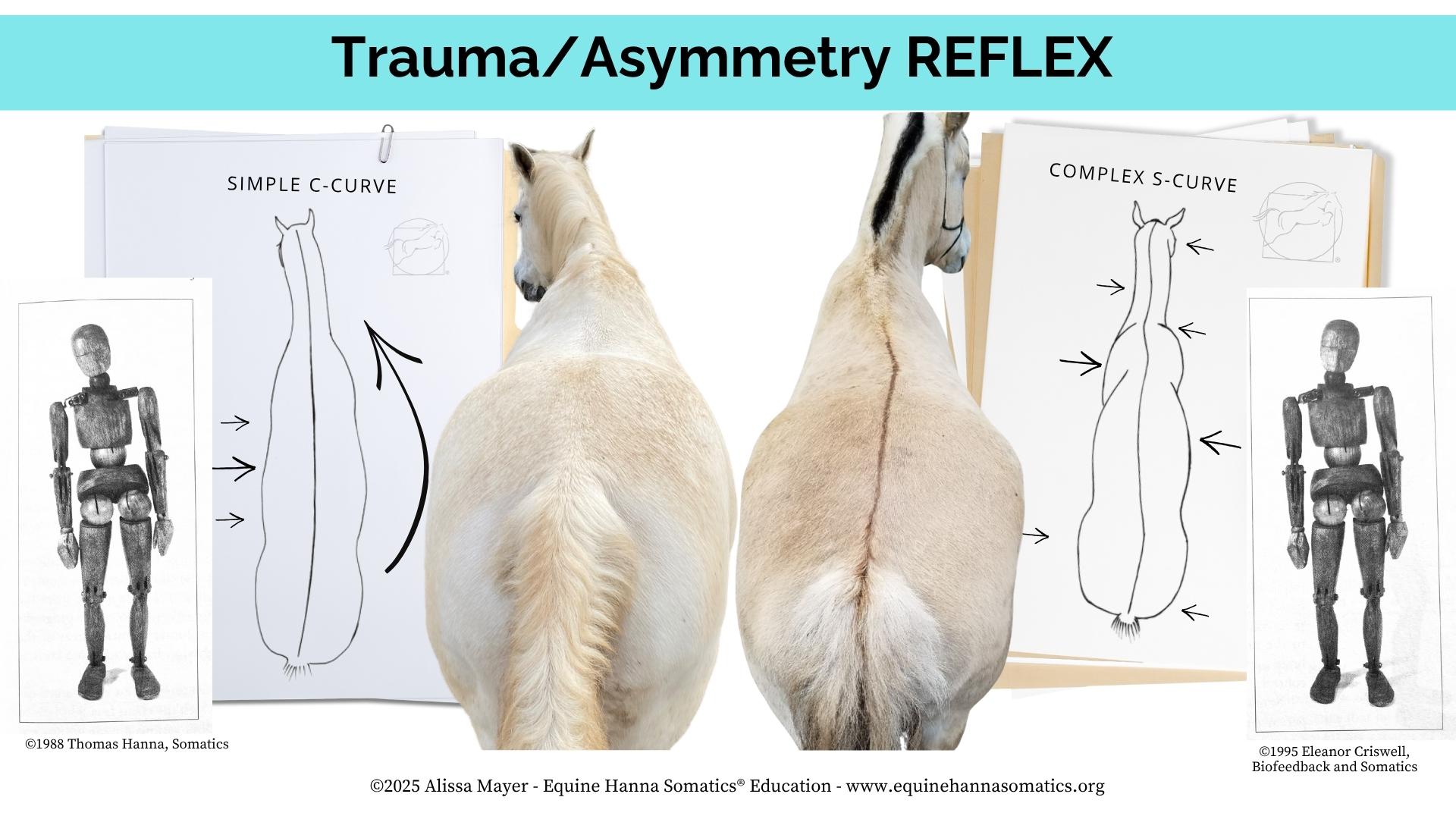
The Trauma/Asymmetry Posture (ie. crookedness) is often mistaken for laterality or "natural asymmetry" and it shows up when a horse is habitually contracting the muscles on one side of their body more strongly than the other.
This is typically an Antalgic (pain-avoidance) Response involving the withdrawal and crossed-extensor reflexes that becomes habituated, OR it can be learned from repetitive motion...
Before we can accurately assess conformation, asymmetry, soundness, strength or behavioral issues, we must identify and address the involuntary habitual tension that is pulling the horse out of alignment and creating the persistent postural deviations, functional weakness and crookedness everyone is trying to 'correct.'
The role of Equine Hanna Somatics® is to help a horse's brain recognize inefficient and unconscious muscle contractions that are no longer useful, so they can regain conscious control over their own muscles and, therefore, also regain access to their full range of motion, comfort, strength and endurance."
- Alissa Mayer, BSc(Equine) C-EHSE
Director of the EHS Professional Training Program
The BENEFITS
Case Studies and Published Research
Cognitive Enhancement
Athletic Performance
Injury Prevention
Real-life stories and studies that show the benefits of Hanna Somatic Education on body & mind.
Assessing Outcomes of Equine Hanna Somatics
To put it as simply as possible, the main objective outcome of Hanna Somatics, regardless of the species doing the movements (horse, dog, human, etc.) is to cause an internally mediated normalization of habitual resting muscle tonus, thereby allowing the individual to return to the natural state of automatic organization, self-carriage and self-regulation of a healthy, living biotensegrity system, free from the affects of motor sensory amnesia.
How does EHS work?
We achieve this by inviting each individual to temporarily change the level of brain control over their skeletal muscles during a series of somatic exercises, following a unique set of principles (founded in basic neuroscience) that specifically engage the voluntary motor cortex area of the brain to control the somatic movements. There are many different parts of the brain and spinal cord that are involved in triggering or controlling muscle contractions, but only impulses from the voluntary motor cortex can dynamically influence the de-contraction (aka lengthening or ‘relaxation’) of the muscles, which allows the nervous system to ‘reset’ the default resting length of each muscle, aka the resting muscle tonus, or tone. Immediately after finishing the somatic exercises, conscious movement control is relinquished and given back to the body’s incredibly advanced autopilot system.
Long-lasting Changes in Resting Muscle Tone
The changes in resting muscle tone levels that result from Hanna Somatics are both immediate and very long-lasting, with noticeable improvements during and after the very first session, and results that generally persist and cumulatively improve over the following days, weeks, months and even years!
Ideally, resting muscle tone should be maintained at the lowest possible level to efficiently maintain the body’s tensegrity and attention or ‘readiness to move’ - without wasting energy or reducing the available length or strength of the skeletal muscles. Unfortunately, over time and repeated exposure to stressors, horse and humans alike tend to accumulate chronic tension in layers as part of our adaptive responses to daily life. So every Hanna Somatic session begins with a pre-assessment of posture, movement and range-of-motion to gather information about which skeletal muscles are experiencing abnormal resting tone.
In Equine Hanna Somatics, deviations in normal resting muscle tone are subjectively observed and measured in three ways:
Visual inspection of static posture, body organization, muscular development/tone, asymmetries, facial expression and overall wellness. Like people, horses tend to develop global patterns of chronic muscle contractions that produce one of three characteristic habitual postures (or combinations of these postural patterns) often accompanied by co-contractions that create areas of excessive stiffness.
Visual inspection of movement at the walk from various viewpoints, observing dynamic posture and body organization, movement quality in key areas, range-of-motion, length of stride, limb trajectory, etc. and overall wellness. The movement (or lack of normal movement) will reflect the areas where shortened muscles are not allowing full joint range-of-motion or are actively pulling the limbs or axial skeleton out of neutral alignment.
Hands-on assessments of joint Range-of-Motion and Palpation of resting muscle tone in palpable muscles with a gentle, flat-finger technique are included before, during and after each session for confirmation of muscle tone or ROM changes, observing pain signals or areas of discomfort, texture, temperature, etc.
Objective vs. Subjective Markers
Due to both the nature of working with horses outside of a laboratory setting, and to the very rapid changes observed in horses posture and muscle tone during and following any EHS exercises or sessions, we do not frequently utilize any objective measurements or markers (like measuring joint angles or the degree of drop or ‘sway’ in the horses back) for assessing outcomes. The exception is taking before/after photos and videos to track progress and record postural patterns and changes over time.
During and after each EHS session, changes in muscle tone are continually observed with the same three techniques described above - by assessing the changes in static posture, changes in movement quality/ability, and by palpating the muscles directly.
Top Subjective Markers of Improvement post-EHS:
Improvements in Global Postural Organization as the whole body is systematically freed from the constant pull of various chronically shortened muscles, and released from the associated reflexive inhibition of the opposing muscles or muscle groups, tensegrity is restored and the automatic postural reflexes are able to resume their unconscious self-regulation and balancing functions.
Postural improvements are immediately noticeable in both the Static Posture (resting stance) and Dynamic Posture (in movement) during and after an EHS session. Visually apparent reductions of various postural deviations are observed by noting: the horse being more squarely balanced over all four limbs with the cannon bones more vertical and the joints bending appropriately, the head and neck held lower, the neck becoming longer and more arched, the back becoming more neutral, less extended or less roached, changes in shoulder and pelvic angles, decreased lateral spinal asymmetries or deviations in axial rotation, appropriate engagement of the thoracic sling muscles, and more…
Improved Range-Of-Motion - Muscles with a neutral resting tonus are effortlessly able to contract to produce forces and to lengthen to their maximum natural length as needed during movement.
This is visually apparent when watching the horse move during and after the EHS session, and noticeable via feel during subsequent hands-on EHS exercises or passive range-of-motion or meanswhereby movements, as well as noted by riders post-EHS. Specifically you many note changes in length of stride, a return to a healthy ‘J’ swing of the head at the walk, increased rotation of the scapula, more oscillating mobility through the barrel and lumbo-sacral areas, easier/deeper breathing, less preference for bending or traveling more in one direction or on a particular lead in canter, ease in getting down to roll, rolling over more easily and ‘popping effortlessly back to their feet’ and general improvements in performance and organization.
Normalization of the Palpable Tone of individual muscles - As the resting muscle tone returns to a normal neutral, muscles that looked, felt and performed abnormally immediately improve as they are freed from the internal compression or reflexive reciprocal inhibition produced by chronic muscle contractions.
The chronic contraction and shortened position of a muscle (or group of muscles) with elevated resting tonus is clearly palpable - a muscle with high tone will feel hard, may bulge or be flat, dry or ‘ropey’ with little give, and may appear overdeveloped (hypertrophic) or atrophied, depending on the level of tone the duration of the chronic contraction, which can persist for days, weeks, months, years or longer.
Developing Feel
With practice, it is possible to highly educate your eye and your hands by building your personal sensory library. Observe and palpate as many horses as you can! Even without much practice, most people can immediately feel the changes in resting muscle tone using the Goldilocks principle (noting muscles that feel too hard, too soft, or ‘just right’) and by comparing the feel of muscles before and after a specific somatic exercise or a full EHS session. EHS Educators (what we call our student and certified practitioners) often encourage the horse owner to participate in the palpation assessments before and after EHS sessions.
Additional Benefits of Equine Hanna Somatics
The many other benefits of EHS (improvements in endurance, performance, learning/trainability, willingness, self-carriage, hoof balance, relaxation, overall health, well-being and happiness; reductions in pain, stiffness, behavior issues, stereotypies/vices, injuries; the ‘spontaneous’ resolution of mysterious or undiagnosed lameness issues; increased bonding with the owner/trainer/handler, improved social interactions, actualization of intelligence and performance potential, reclamation of lost social status within the herd - and more!) are frequently owner-reported observations.
EHS has applications across the full spectrum of equine health, training and management...
From helping horses with severe lameness or persistent compensation patterns that nothing else is able to solve, to reversing many of the symptoms of ‘aging’ that cause loss of performance, end athletic careers or create unnecessary suffering for horses in their golden years, to preventing future injuries, offering sound and healthy horses a faster track to living up to their potential, EHS offers a fast-track to helping horses become their ‘best-selves’ or what we call Actualized.
EHS is a gentle, natural approach that is extremely complimentary to all other training, treatment or therapeutic methods and with very few contraindications. Because it is based on proven neuroscience and neuromuscular physiology, and requires that the horse actively participates in the work (not just yawning or ‘releasing, or giving feedback about what it likes or where it does or does not want you to ‘work’ next) - it is easy to learn, safe and effective for all ages and stages of horses.
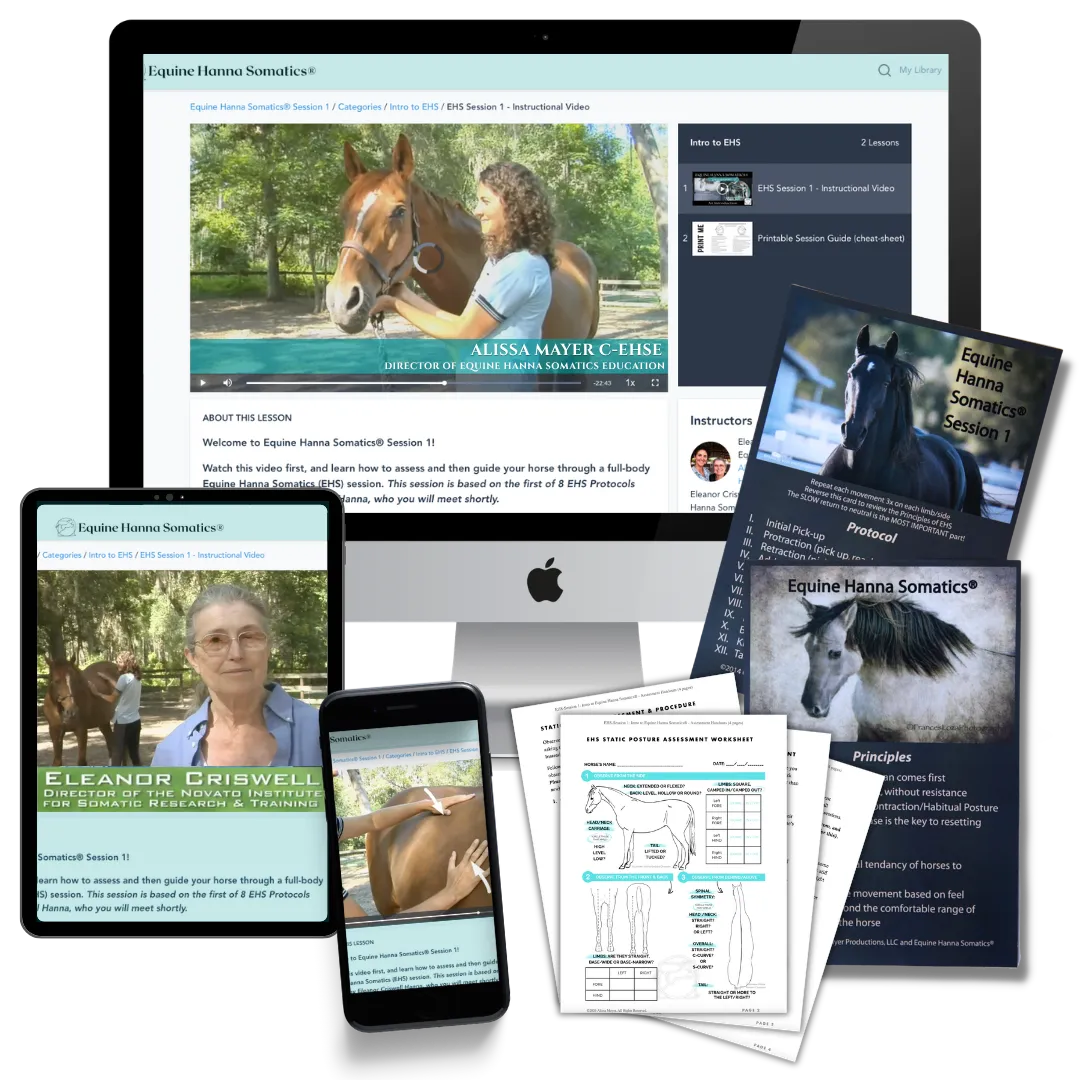
We want every domestic horse in the world to experience the profound relaxation and interspecies bonding that results from this revolutionary work. So we’re on a mission to teach every horse owner, rider, trainer and animal lover how to guide their horses through some basic EHS exercises that can be easily integrated into any grooming or training routine. You can learn 3 of our favorite somatic exercises for every horse in the free eBook available here, or scroll down to purchase our introductory course, which teaches a basic full-body EHS session, how to assess your horse before and after EHS, and includes a short introductory lesson on how to do Hanna Somatics with your own body too!
REFERENCES
Kopecká, B., Ravnik, D., Jelen, K., & Bittner, V. (2023). Objective Methods of Muscle Tone Diagnosis and Their Application-A Critical Review. Sensors (Basel, Switzerland), 23(16), 7189. https://doi.org/10.3390/s23167189
Tabor, G., & Williams, J. (2020). Objective Measurement in Equine Physiotherapy. Comparative Exercise Physiology, 16(1), 21-28. https://doi.org/10.3920/CEP190049
Sharp, Y. (Jan 12, 2023). Neuro-Bio-Tensegrity, the Push Puppet Effect, The Equine Documentalist https://www.theequinedocumentalist.com/post/neuro-bio-tensegrity-the-push-puppet-effect
Criswell, E. & Mayer, A. (2006-2025) Equine Hanna Somatics® Professional Training Program Manual
EHS is not something that can be done TO a horse by the practitioner, but is a voluntary activity that we facilitate. It's a guided conversation we invite a horse to have WITH their own nervous system."
- Ryan Moschell LMT, CHSE
Director of the HSE Professional Training Program, EHS Education Co-instructor
GET THE INTRODUCTORY ONLINE COURSE
Equine Hanna Somatics - SESSION 1
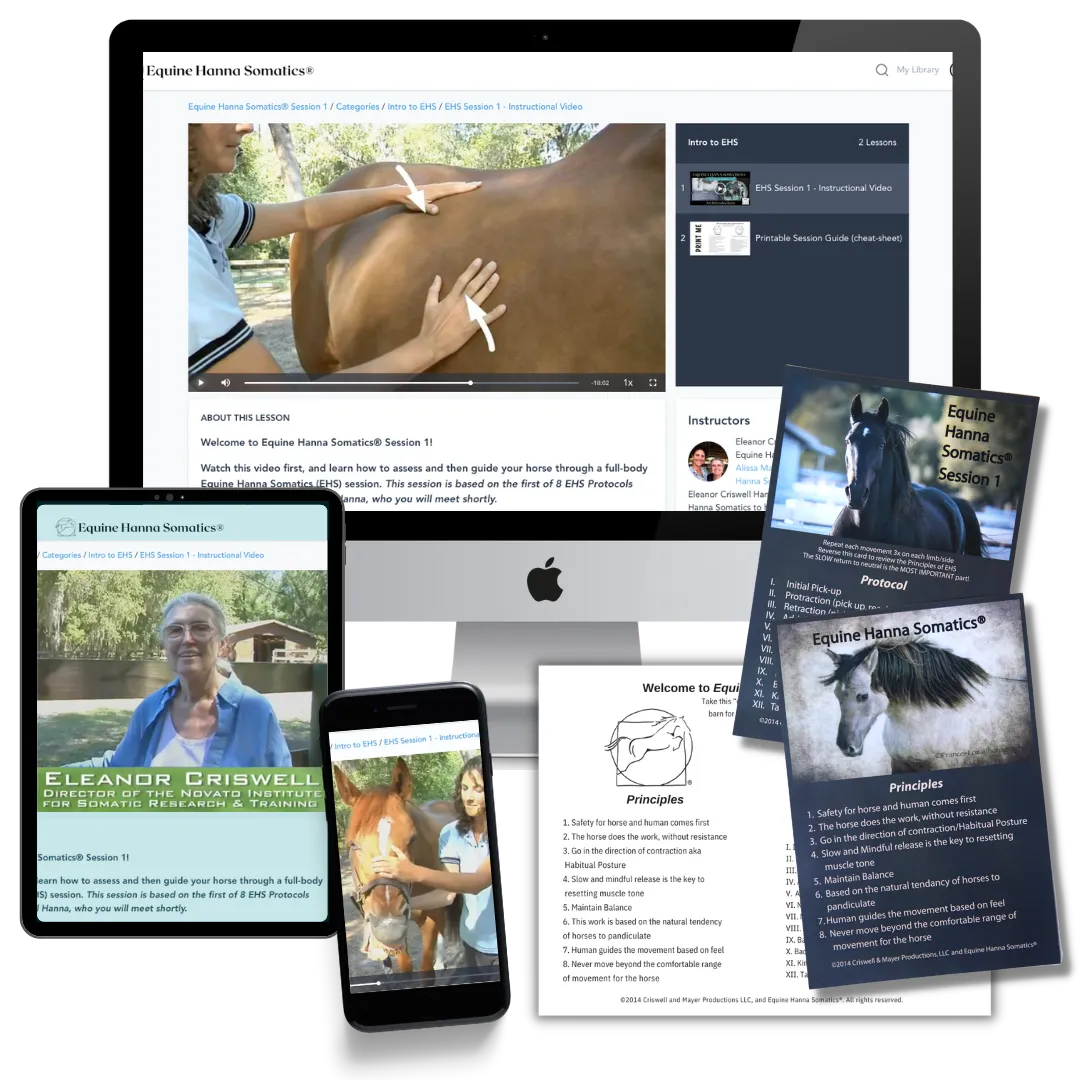
Watch a full-body Equine Hanna Somatics® session, including pre- and post-session assessments, and learn how to start doing EHS with your own horse, TODAY!

Disclaimer: Equine/Canine/Human Hanna Somatics is not bodywork or manual therapy, and is not a diagnostic or treatment tool. The information included on this website and in any affiliated programs is intended for educational purposes only and is not meant to take the place of professional veterinary or medical advice, may not be current, and is subject to change without notice. We encourage all members of the community to seek guidance from a licensed veterinarian, physician or allied healthcare practitioner regarding specific medical concerns or questions about your own or your animal’s health.
EQUINE HANNA SOMATICS® EDUCATION



INFO
LEARN
LEGAL
©2014-2026 Criswell & Mayer Productions LLC and Feel, Embodied LLC. All Rights Reserved.