
The Equine Hanna Somatics® BLOG
How Does Equine Hanna Somatics® Work?
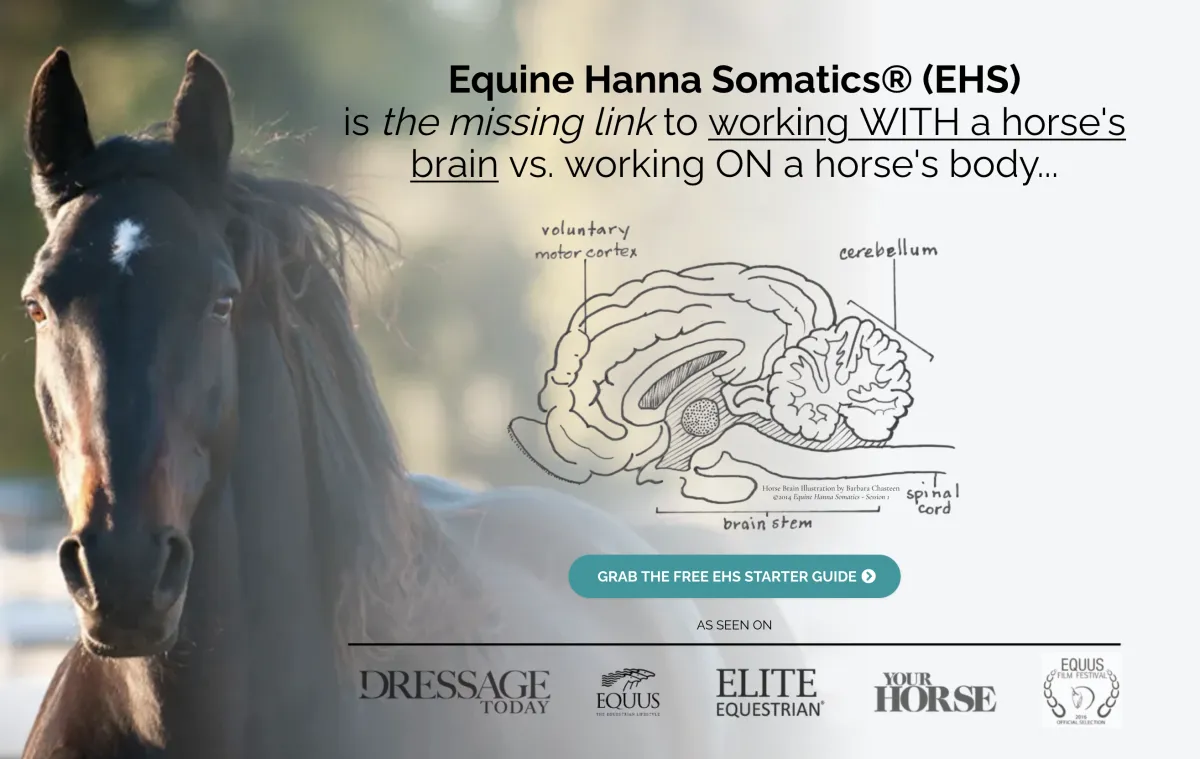
Equine Hanna Somatics® (EHS) is a neuroscience-based, reliable and safe approach to rapidly help horses gain the performance and well-being benefits many therapeutic approaches and ‘bodywork’ methods promise, but can’t always deliver…

EHS is an adaptation of Hanna Somatic Education®, the proven, natural and safe method of pain relief and sensory-motor training developed by Thomas Hanna for people, and later modified and applied to animals by Eleanor Criswell. Like humans, horses experience stress and develop chronically contracted muscles that restrict movement and cause discomfort.
Over time, these chronic, low-level muscle contractions, which can also be described as “tension” or “tight muscles,” become incorporated into the horse’s default habitual posture. This is known as Motor Sensory Amnesia (MSA or SMA—more on this later).
Once this happens, performance, range-of-motion and comfort are reduced, and the new postural patterns are difficult to change, even with gymnastic training, in-hand ‘straightness’ training, or even most bodywork or manual manipulation techniques. Instead, EHS goes straight to the root cause of the tension – the horses brain – to unwind the distorted habitual posture and free up the horses natural conformation and alignment.
What happens in a session with an Equine Hanna Somatics® Educator (EHSE)?
The role of EHS is to help a horse recognize inefficient and unconscious muscle contractions so she or he can regain conscious control over her or his own muscles and, therefore, also regain access to her or his full range of motion, comfort, strength and endurance….

We do this by guiding each horse through a customized series of somatic movements that invite the horse to deliberately engage various muscles and muscle groups during both the concentric AND eccentric phases of muscle contraction. We are able to do this using a unique approach based on the horse's natural tendency to pandiculate, called Voluntary Pandiculation (the innovative technique developed by Hanna and named by Criswell). When horses pandiculate, one of the outcomes is that the horse will reset their brain stem mediated resting muscle tonus of the muscles involved back toward their normal neutral levels.

Every session with a professional Equine Hanna Somatics Educator (find one in our practitioner directory) begins with an assessment that includes observing static posture, muscle tone palpation, and watching your horse in movement to determine which muscles are abnormally contracting and whether EHS is indicated or contraindicated for your horse. Based on our assessment, we'll choose the appropriate EHS protocol and modify it as needed for each individual horse as we guide them through the somatic movements. We always finish with a post-session assessment and usually will teach you up to 3 exercises to do with your horse as 'homework' between full sessions.
Each horse chooses how long the active part of the session will last, and the whole thing usually takes 1-2 hours (depending on how familiar the horse is with EHS work). Typically we recommend scheduling a bundle of 3 EHS sessions in the first week or month, then scheduling 3 weekly or monthly follow up sessions, based on the horse's progress, work-level and individual needs.
Can horses be ridden after Equine Hanna Somatics®?
Horses should not be worked, ridden or turned out in challenging terrain or with aggressive horses for several hours after an EHS session - but they do need to move around to integrate their changes in muscle tonicity and update their cortical maps of body awareness. Hand-walking, gentle integration exercises or turn-out in a safe environment with room to move and access to fresh water are all appropriate post-EHS. Some horses will want to sleep before moving around, and this is also acceptable!
Riding BEFORE doing EHS is fine, as long as the horse has had time to dry off and completely cool down before beginning (usually about an hour).
Except in special cases, there is no need to avoid riding or exercise between EHS sessions (for example, most horses can return to 'work' the next morning) because there is no required rest or recovery period after the gentle work, and more movement generally helps horses integrate their results and often even take them further on their own.
By working with the natural movements and neuromuscular physiology of a horse, we are able to facilitate the horse having a conversation with their own nervous system that produces rapid and profoundly beneficial results that do not 'wear off' after each session. In fact, the results are cumulative, incredibly reliable and so long-lasting they are described as semi-permanent.

The results of EHS are so reliable that almost anyone can help their horse enjoy the benefits of the basic somatic exercises. Just by doing the Initial Pick-up movement (try it here), a horse will reset their default tension levels in more than 30 muscles!
When this happens, we are both reversing and preventing the condition Hanna called Sensory Motor Amnesia, and that Criswell later re-coined as Motor Sensory Amnesia, to more accurately reflect the nature of Hanna Somatic Education as a 'motor intervention.'
What is Motor Sensory Amnesia (MSA)?
As both the body and the brain adapt to stress or repetitive motion as a survival mechanism, the muscles involved become more and more contracted. This 'new normal' state of muscular hypertonicity becomes integrated into the brain’s autopilot system through the primitive learning process called 'habituation.' Once the adaptations become habituated (aka on autopilot, or in ‘muscle memory’), the horse's brain stem (unconsciously) maintains the new default levels of muscle tone and postural organization, effectively forgetting what it felt and moved like before. This is Motor Sensory Amnesia.
A horse with motor-sensory amnesia may show adaptations like:
Chronic Stiffness or Bracing
Crookedness, Asymmetry or apparent ‘Muscle Atrophy’
Changes in Posture or Way of Going
Having a ‘Good’ Side and a ‘Bad’ Side (or direction)
Lumps, Bumps or ‘Weird Conformation’
Short-Striding or an Uneven Stride
And have symptoms like:
Pain, Soreness or ‘Shifting Leg Lameness’
Loss of Range-of-Motion (ROM)
Weakness, Fatigue or Low Energy
Poor Attitude, Disconnected or Aloof
Negative or Stereotypical Behaviors
Loss of Peak Performance
other Symptoms of ‘Aging’
Although MSA cannot be cured by drugs, treatment, manual manipulation or surgery, it CAN be controlled consciously after the relearning process facilitated during an Equine Hanna Somatics session, which allows the horse's own nervous system to recognize and then normalize any maladaptive habitual muscle contractions (aka 'compensations' or 'maladaptive compensatory posture' or 'compensation patterns').
Said another way, EHS can both reverse the horse's existing maladaptive compensations related to chronic muscle tension AND prevent future accumulations of Motor Sensory Amnesia too!

The BENEFITS of Equine Hanna Somatics include:
Performance and athletic enhancement
Restored and expanded body awareness and motor control
Improved soundness, comfort, and overall health and wellness
Reduced asymmetry and improved posture
Increased range of motion, elasticity and length of stride
More flexibility, suppleness & straightness
Career/life extension and injury prevention
Enhanced endurance and recovery
Overall relaxation and well-being
Increased willingness and improved attitude or work ethic
Increased bonding with the handler/rider
and more!
RESOURCES
Criswell, E. & Mayer, A. (2006-2025) Equine Hanna Somatics® Professional Training Program Manual
Hanna, T. (1988) Somatics - Reawakening the Mind’s Control of Movement, Flexibility and Health. Da Capo Press
EHS Professional Training and Certification Program: https://www.equinehannasomatics.org/training
DIY INSTRUCTIONAL VIDEO/COURSE
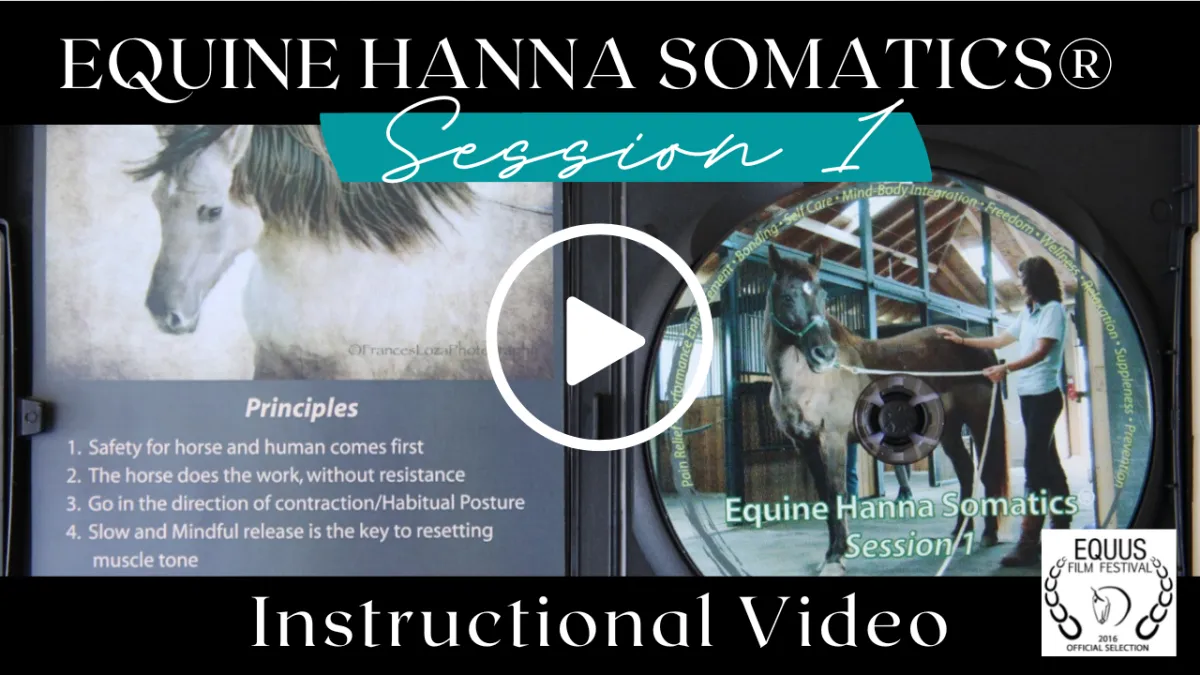
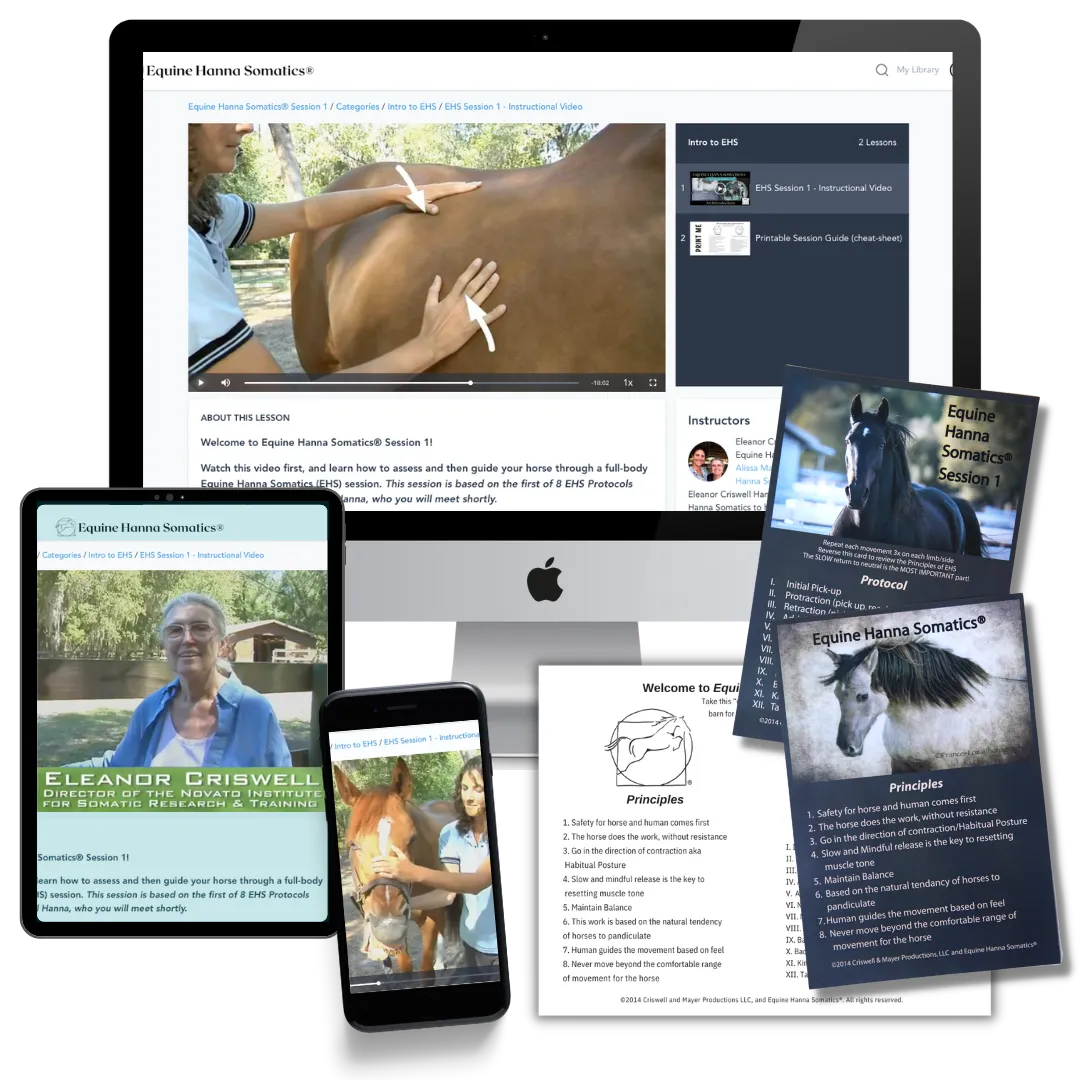
Equine Hanna Somatics - Session 1
Watch a full-body Equine Hanna Somatics® session with a horse, and learn how to start doing EHS with your own horse! >>>

Disclaimer: Equine/Canine/Human Hanna Somatics is not bodywork or manual therapy, and is not a diagnostic or treatment tool. The information included on this website and in any affiliated programs is intended for educational purposes only and is not meant to take the place of professional veterinary or medical advice, may not be current, and is subject to change without notice. We encourage all members of the community to seek guidance from a licensed veterinarian, physician or allied healthcare practitioner regarding specific medical concerns or questions about your own or your animal’s health.
EQUINE HANNA SOMATICS® EDUCATION



INFO
LEARN
LEGAL
©2014-2026 Criswell & Mayer Productions LLC and Feel, Embodied LLC. All Rights Reserved.