
The Equine Hanna Somatics® BLOG

Your Horse Doesn't Have a Weak Thoracic Sling
...BEFORE you 'teach' a horse to LIFT their withers or thoracic sling 🙏 help them FREE their tight spinal extensor muscles!

The thoracic sling is only one of several ‘slings’ or collections of muscles in the horses body, and they all work together to maintain balance, equilibrium, readiness for movement and biotensegral integrity…
Only the muscles below the vertebral column can lift the spine into flexion (at the base of the neck, or anywhere else) and contraction of any muscle above the vertebral column can only produce spinal extension and downward pressure on the neck and torso/barrel...
With this in mind, BEFORE we ask a horse to lift the withers/base of the neck/thoracic sling area it’s important to always make sure that the horse isn't experiencing any involuntary or habitual contractions of the spinal extensor muscles, because if they are, they will find it very difficult or uncomfortable to lift their back or base of the neck, flex their spine or carry a rider comfortably.
When the spinal extensor muscles are tight, horses will typically present in a posture dominated by the Green Light Reflex, a tendency to be high-headed, spooky or inverted/upside-down in movement and posture, and/or have a flat, lumpy, hollow or underdeveloped topline.
One of the easiest indicators for most horse owners to see is the ‘dip’ in front of the withers - which happens when the cervical trapezius and rhomboid muscles are contracted, pulling the top of the scapula forward and the middle of the neck up and back.
Even when the spinal extensors are tight, which is unfortunately very common for horses all over the world, if we ask, most horses will still find a way to lift 'incorrectly' by using their head/neck to create the upward movement with momentum. IF they are able to lift the withers despite the contractions from the opposing spinal extensor muscles, they will do so by exerting more effort and energy than it would otherwise require to lift, as well as cause increased wear and tear on themselves.
Horses don't use the 'wrong muscles'
This ‘incorrect’ type of movement is NOT because horses are ‘using the wrong muscles’ as is often said, but is the result of involuntary spinal cord level reflexes and the mechanical forces created by the strong and sustained contraction levels.
As long as the spinal extensors are actively contracting (the agonists), the spinal flexors (antagonists) will be reflexively inhibited (by reciprocal inhibition) and mechanically lengthened, making it difficult or impossible for the horse to contract and use the strength of their spinal flexor muscles - this is called ‘stretch weakness’ and is responsible for what most trainers and vet-rehabbers misunderstand as a ‘weak core’ or 'deactivated thoracic sling.' 🤔
Once a horse has been freed from the downward pressure and compression of the contracting spinal extensor muscles, the natural elasticity and normal neutral resting myofascial tonus of the 'thoracic sling' and other important muscles of the somatic center are able to effortlessly suspend and support the forehand, neck and back (as designed).
From here, most horses are easily able to find and contract the smaller muscles at the base of their neck as needed that produce the 'wither lift,' bascule and neck telescoping gesture that we all desire and like see! (For the anatomy nerds, those are the scalanus and longus colli muscles).

This horse is at the very beginning of his new Equine Hanna Somatics practice with his owner. At the time these photos were taken, they had only managed to try 3-4 of our introductory EHS exercises, and already we can see the positive changes in his topline and neck muscles as he is beginning to reduce his chronic default tension levels.
Well done Bonita Vear, and thank you for giving me permission to share your photos and your work! 🦄
RESOURCES:
Bennett, D. (2008) The Ring of Muscles Revisited. Equine Studies Institute. https://www.equinestudies.org/_files/ugd/7f2126_2556d8249bce44a39404cc990de8574c.pdf
Criswell, E. & Mayer, A. (2006-2025) Equine Hanna Somatics® Professional Training Program Manual
Haussler, Kevin DVM, DC, PhD, DACVSMR (2025) Understanding Biotensegrity in Animals. Veterinary Compendium. https://vetcompendium.org/understanding-biotensegrity-in-animals/
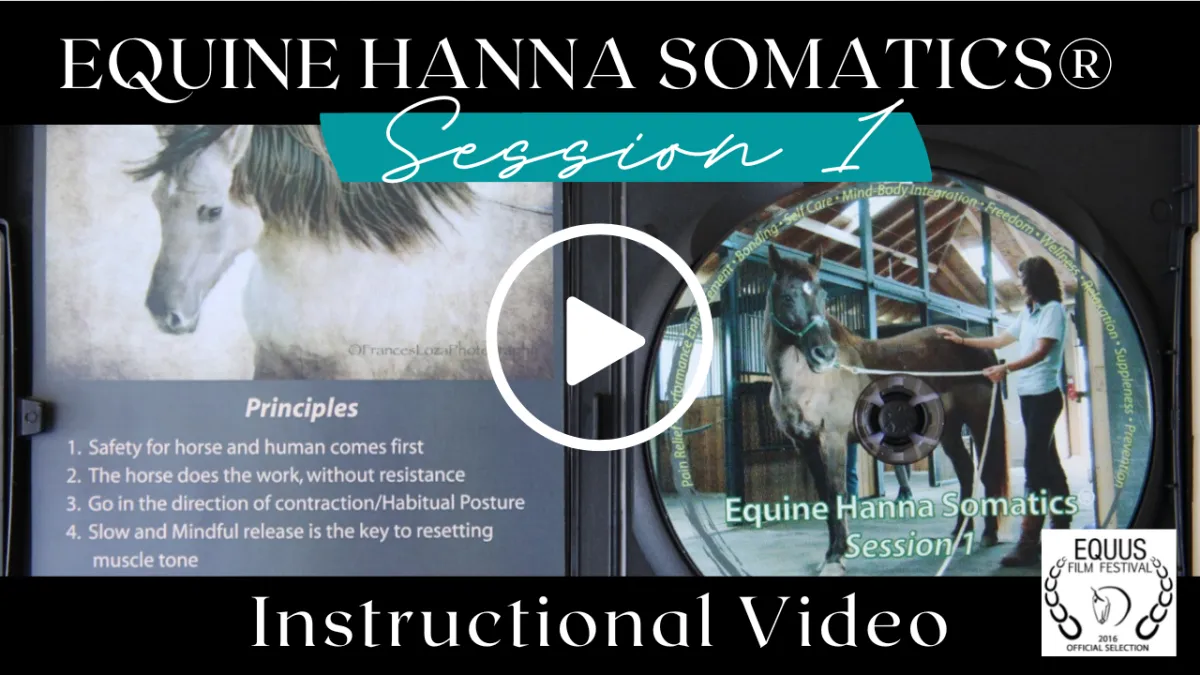
DIY INSTRUCTIONAL VIDEO/COURSE
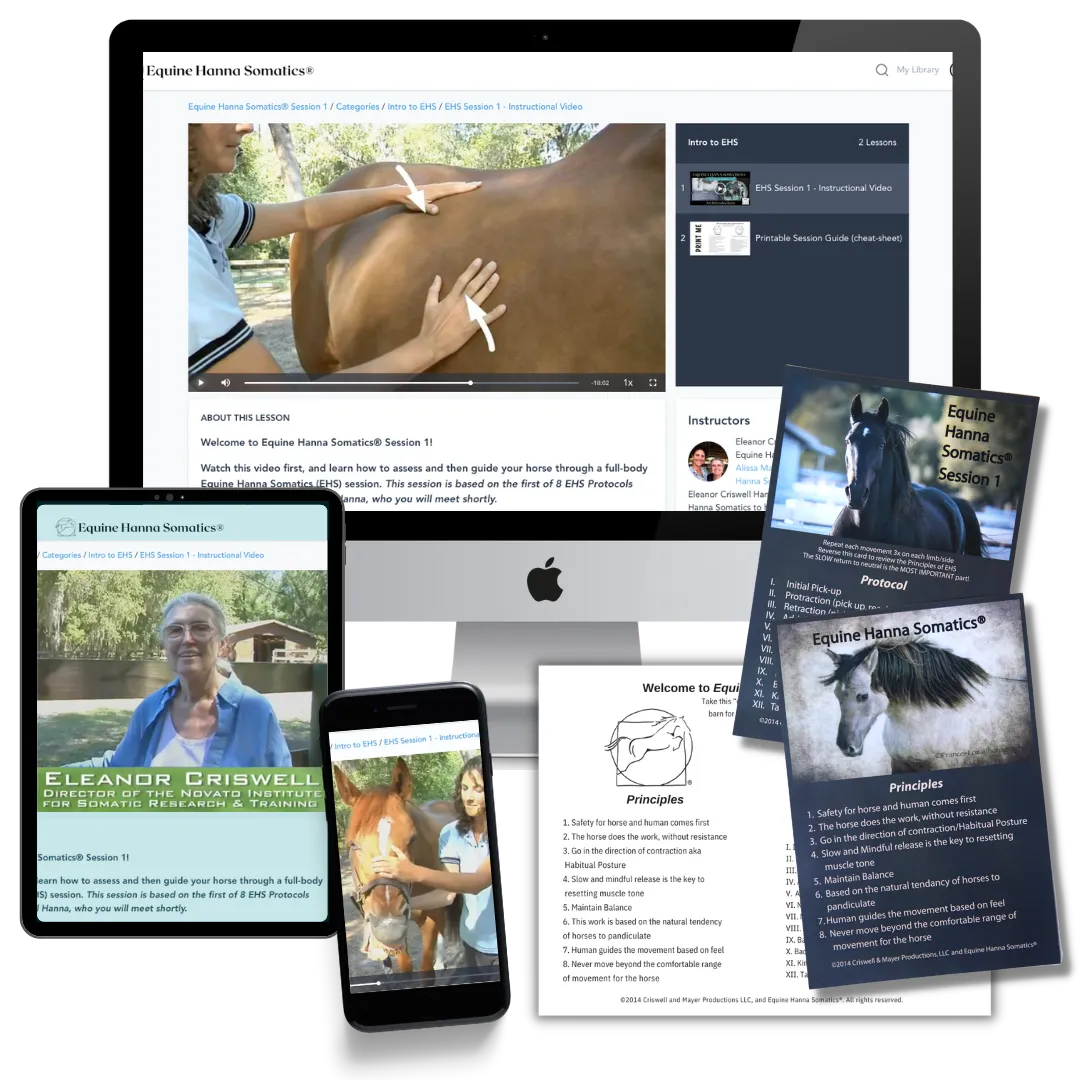
Equine Hanna Somatics - Session 1
Watch a full-body Equine Hanna Somatics® session with a horse, and learn how to start doing EHS with your own horse! >>>
Disclaimer: Equine/Canine/Human Hanna Somatics is not bodywork or manual therapy, and is not a diagnostic or treatment tool. The information included on this website and in any affiliated programs is intended for educational purposes only and is not meant to take the place of professional veterinary or medical advice, may not be current, and is subject to change without notice. We encourage all members of the community to seek guidance from a licensed veterinarian, physician or allied healthcare practitioner regarding specific medical concerns or questions about your own or your animal’s health.
EQUINE HANNA SOMATICS® EDUCATION


INFO
LEARN
LEGAL
©2014-2026 Criswell & Mayer Productions LLC and Feel, Embodied LLC. All Rights Reserved.